How does cultivated beef taste compared to beef? Cultivated beef, grown from animal cells, is real meat but has a sweeter, less bitter taste due to higher levels of amino acids like glycine and alanine. However, it lacks some savoury depth (umami) because of lower levels of inosine-5'-monophosphate (IMP) and aspartic acid.
Key Points:
- Sweetness: Higher in cultivated beef.
- Bitterness: Lower in cultivated beef.
- Umami (savoury taste): Stronger in beef due to higher IMP.
- Texture: Similar in ground forms like burgers.
- Juiciness: Beef relies on natural marbling, while cultivated beef uses engineered fat distribution.
Scientists are working to improve cultivated beef's flavour by adjusting amino acid levels and integrating fat better. While cultivated burgers perform well, whole cuts like steaks are still a challenge.
What does cultivated meat really taste like?
sbb-itb-c323ed3
What Creates Beef Flavour
Beef flavour comes from a mix of free amino acids, fat, and nucleotide compounds like inosine-5'-monophosphate (IMP). When cooked, these elements interact through the Maillard reaction, producing the browned, savoury aromas we associate with beef.
Fat plays a central role in flavour development. Nanette Boyle, a chemical engineer from the Colorado School of Mines, explains:
"Most of the flavour profile of the meat is due to the fat and the marbling" [5].
As beef cooks, its fat oxidises, releasing volatile compounds such as aldehydes, alcohols, ketones, and furans. These compounds are what give beef its signature aroma, making marbling a key factor in taste.
In addition to fat, myoglobin, an iron-containing protein, impacts both the colour and the metallic, bloody notes often found in rare beef. The interplay of amino acids and nucleotides also shapes the meat's flavour, influencing whether it tastes sweet, bitter, or intensely savoury.
Amino Acids and Taste
Each amino acid contributes its own flavour characteristics. For instance, glutamic acid and aspartic acid create the umami, or savoury, depth. Meanwhile, glycine, alanine, threonine, proline, and serine add sweetness. On the other hand, amino acids like isoleucine, leucine, valine, and phenylalanine are linked to bitterness [2][4].
This is where cultivated beef stands out in early taste tests. A 2023 study by the University of Tokyo revealed that cultivated muscle cells contain double the free amino acids of conventional beef. This results in a sweeter, less bitter flavour profile, with higher levels of glycine, alanine, and serine, and reduced amounts of bitter amino acids like leucine and valine [2][4]. Shoji Takeuchi, the study's senior author, remarked:
"The surprise was that the levels of free amino acids in cultured muscle cells were actually double those in conventional beef" [4].
The nutrient-rich growth medium used to feed the cells plays a critical role in determining these amino acid levels. Takeuchi elaborated:
"Increasing levels of a particular amino acid in the medium increased the levels in the cells... this means we should be able to control the flavour profile of cultured meat" [4].
This controlled production process is what gives cultivated beef its distinct flavour profile, shaped by variations in amino acids. These differences also affect umami intensity, as discussed next.
Umami and Savoury Flavour
Umami is the savoury, brothy depth that defines beef's flavour. This sensation comes from two main compounds: glutamic acid (an amino acid) and inosine-5'-monophosphate, or IMP (a nucleotide). Together, these compounds amplify each other's effects, creating a richer savoury taste than either could achieve alone [2].
However, cultivated beef typically has lower IMP levels, which weakens its umami intensity [2]. While its glutamic acid levels are comparable to conventional beef, aspartic acid levels are noticeably lower [2]. This combination means cultivated beef may lack some of the classic "meaty" depth found in traditional beef – at least for now.
Researchers are aware of this shortfall. As Seon-Tea Joo and colleagues highlighted:
"Since the umami attribute of meat is important for good taste, simulating glutamic acid and aspartic acid... is important" [2].
The challenge lies in mimicking not just the amino acids but also the nucleotides that conventional beef naturally develops through the metabolic processes of living animals. This remains a key area of focus for improving the flavour of cultivated beef.
Flavour Comparison: Cultivated Beef vs Conventional Beef
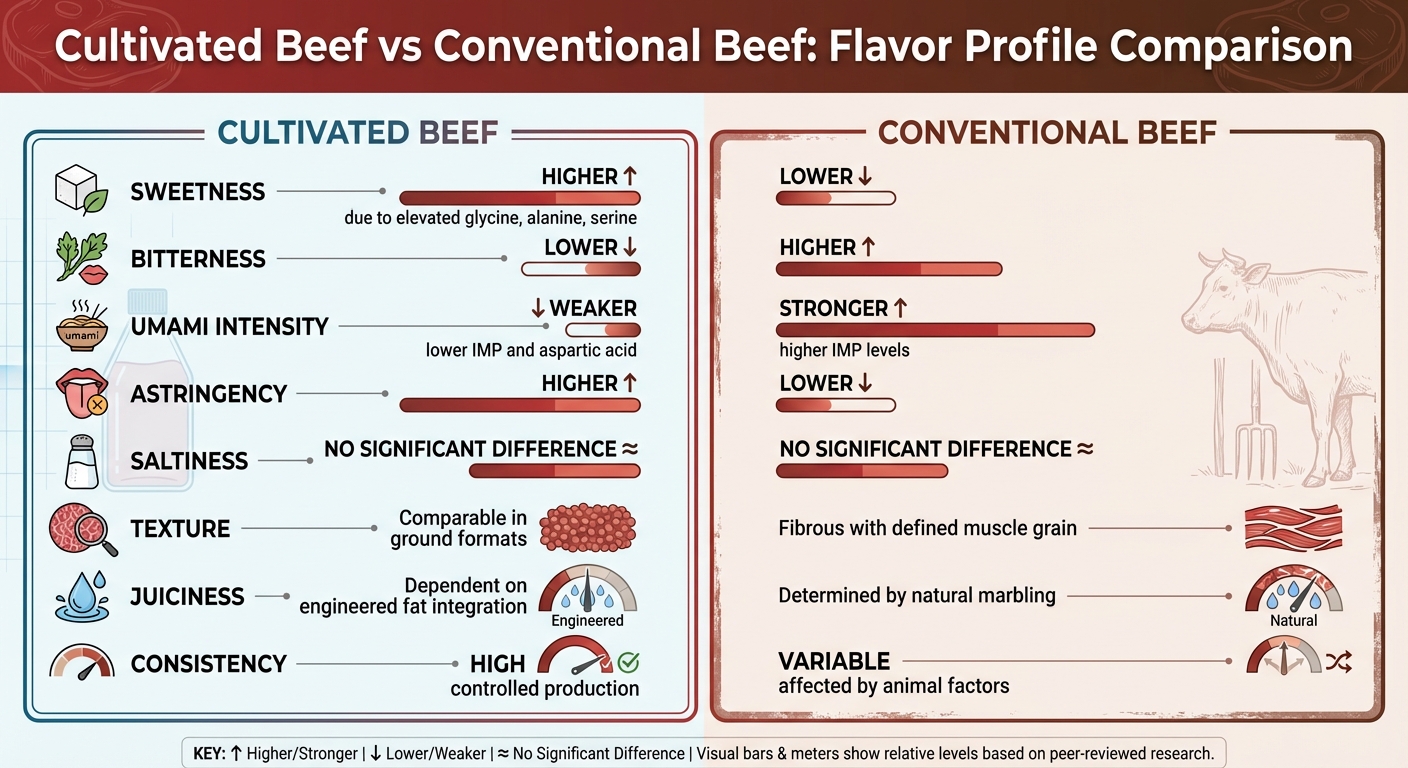
Cultivated Beef vs Conventional Beef: Flavor Profile Comparison
Sweetness, Bitterness, and Taste
Cultivated beef tends to be sweeter and less bitter than conventional beef, thanks to its higher levels of amino acids like glycine, alanine, and serine. As researchers Seon-Tea Joo and colleagues observed:
"The significantly higher amounts of serine, proline, glycine, and alanine in CMT [cultivated meat tissue] than in TM [traditional meat] suggest that CMT may be sweeter than TM" [2].
In contrast, bitterness is reduced in cultivated beef because it contains fewer bitter-tasting amino acids, such as leucine, isoleucine, and valine [2].
However, cultivated beef falls short when it comes to umami intensity. This is due to its lower levels of inosine monophosphate (IMP) and aspartic acid. It also has a more pronounced astringency compared to conventional beef, while saltiness levels remain similar between the two [2].
Texture and Juiciness
The texture of cultivated beef also sets it apart. In ground forms like mince or burgers, it performs similarly to conventional options [3].
Juiciness, however, is a more nuanced topic. Conventional beef achieves its juiciness through natural marbling, a result of the animal's diet and activity, which releases flavour as it cooks and is chewed. Cultivated beef, on the other hand, relies on engineered scaffolding to distribute fat cells in a way that mimics this marbling effect [1]. This approach ensures a consistent fat-to-muscle ratio, avoiding the variability seen in conventional beef caused by factors like stress, diet, or age [1]. The result? A uniform taste and texture across every batch - something conventional beef can’t always promise. These distinctions open the door for further refinement of cultivated beef’s sensory profile.
Flavour Attributes Comparison Table
| Attribute | Cultivated Beef | Conventional Beef |
|---|---|---|
| Sweetness | Higher (due to elevated glycine, alanine, serine) [2] | Lower [2] |
| Bitterness | Lower [2] | Higher [2] |
| Umami Intensity | Weaker (lower IMP and aspartic acid) [2] | Stronger (higher IMP levels) [2] |
| Astringency | Higher [2] | Lower [2] |
| Saltiness | No significant difference [2] | No significant difference [2] |
| Texture | Comparable in ground formats [1][3] | Fibrous with defined muscle grain [1] |
| Juiciness | Dependent on engineered fat integration [1] | Determined by natural marbling [1] |
| Consistency | High; controlled production [1] | Variable; affected by animal factors [1] |
These distinctions reveal areas where cultivated beef can be tailored even further to enhance its flavour and texture.
Improving Cultivated Beef Flavour
Scientists are making strides in bridging the flavour gap between cultivated beef and its conventional counterpart. By tweaking production processes, they’re finding ways to refine taste profiles and bring cultivated beef closer to the real thing.
Adjusting Amino Acid Levels
In June 2025, researchers from the University of Tokyo revealed an intriguing method for controlling the flavour of cultivated beef. By adjusting the nutrient bath used in production, they could fine-tune its taste. Their findings, led by Mai Furuhashi and Shoji Takeuchi, showed that cultivated beef contains twice the free amino acids found in conventional beef [6]. Moreover, they demonstrated that increasing specific amino acids in the culture medium directly boosts their presence in the cells [6].
"Increasing levels of a particular amino acid in the medium increased the levels in the cells. This is exciting because it means we should be able to control the flavour profile of cultured meat", said Shoji Takeuchi, Senior Author at the University of Tokyo [6].
This discovery allows producers to adjust the amino acid balance, reducing the overly sweet notes caused by high alanine and glycine levels, while enhancing bitterness and complexity to better match conventional beef [2]. Alongside amino acid adjustments, improving fat integration is a critical step in achieving a more authentic taste.
Increasing Fat and Umami
Fat plays a central role in beef’s flavour, and researchers are using 3D scaffolds to replicate the natural marbling found in conventional beef. These scaffolds ensure consistent fat integration, which is essential for both taste and texture. Sensory trials conducted by the Tufts University Center for Cellular Agriculture revealed that while volunteers could distinguish cultivated fat from pork belly, they showed no clear preference for one over the other [5]. Beyond improving texture, enhancing fat content also helps amplify umami - a key flavour component.
To address the often weaker umami intensity in cultivated beef, scientists are focusing on boosting inosine monophosphate (IMP), a compound responsible for the savoury, "brothy" taste of traditional beef [2]. Researchers at Yonsei University have taken this a step further by developing gelatin-based scaffolds embedded with flavour compounds. These compounds, when heated to 150°C for five minutes, mimic the Maillard reaction, releasing the rich and authentic aromas of grilled beef [7]. This technique not only preserves volatile flavour compounds during the lengthy cell-growth phase but also delivers the deep, browned-meat taste consumers expect [7].
Conclusion
Cultivated beef and conventional beef are both undeniably real meat, made up of muscle and fat. However, research has revealed some notable flavour differences between the two, which scientists are actively working to address. For instance, cultivated beef tends to have a slightly sweeter taste, reduced umami intensity, and higher astringency compared to its conventional counterpart [2].
Encouragingly, significant strides have been made in ground meat products like burgers and nuggets. In these formats, cultivated beef now performs on par with traditional options. Consumer testing has shown growing acceptance, though there’s still room for fine-tuning the sensory experience.
Recent advancements in areas like amino acid control and fat engineering are helping refine the flavour of cultivated beef. By tweaking the nutrient medium, researchers can adjust the amino acid profile, while new scaffolding techniques are improving fat distribution and texture. Efforts to enhance umami flavours and replicate the Maillard reaction - a key process in creating that savoury, browned taste - are also making headway.
While ground products have seen considerable progress, challenges remain in developing whole-cut options like steaks. Even so, cultivated beef continues to evolve at a rapid pace. Its controlled production environment offers unique advantages, such as consistent flavour and the ability to customise, unlike conventional meat, which can vary due to factors like animal stress or diet [1]. As production techniques improve, the flavour profiles of cultivated and conventional beef are becoming increasingly similar, promising a future where cultivated beef meets - and potentially exceeds - consumer expectations for taste and quality.
FAQs
Why is cultivated beef sweeter than beef?
Cultivated beef has a sweeter flavour compared to traditional beef, and this comes down to its unique amino acid profile. It contains elevated levels of amino acids like glycine, alanine, and threonine - compounds known for their ability to enhance sweetness. These differences in composition are what give cultivated beef its distinct taste when compared to conventional beef options.
Why does cultivated beef have less umami than beef?
Cultivated beef tends to have a milder taste compared to traditional beef, primarily because it doesn’t yet replicate the intricate biochemical processes - like amino acid and nucleotide metabolism - that give conventional meat its deep umami flavour. At this stage, these flavour-developing pathways are still being fine-tuned, which is why early versions of cultivated beef lack the richness found in traditional meat.
When will cultivated beef steaks taste like real steaks?
Cultivated beef steaks are projected to mimic the taste of traditional steaks once scientists refine techniques to replicate the deep, beefy flavours that emerge when cooked at high temperatures. Although this breakthrough is expected soon, cultivated beef with these qualities is not currently on the market.