Cultivated meat is no longer just a concept - it’s entering the market, but challenges remain. While many see its potential to reduce harm to animals and the planet, concerns about safety, cost, and taste still hold people back. Here’s what you need to know:
- Interest is growing, especially among younger, urban consumers. Education boosts willingness to try, with clear labelling increasing openness from 16% to 41%.
- Taste and price are deal-breakers. People want cultivated meat to match conventional meat in quality and affordability. Hybrid products (mixing plant and cultivated cells) are helping to lower costs.
- Ethics and sustainability are key motivators. Nearly half of consumers value reduced slaughter and lower emissions. However, energy use in production raises questions.
- Regulatory progress is uneven. The UK is testing products for safety, while Singapore and the US have approved several for consumption.
- Awareness is still low. Many people remain sceptical, associating cultivated meat with artificial or lab-grown labels. Education and trust in regulators like the Food Standards Agency are critical.
The takeaway? Cultivated meat has promise, but success depends on addressing consumer doubts, improving affordability, and ensuring clear communication about safety and benefits.
Trend 1: Growing Consumer Interest and Willingness to Try
Curiosity Drives Consumer Interest
Interest in Cultivated Meat is fuelled by a mix of curiosity, ethical considerations, and concerns for the planet. Many consumers seem to adopt a "try-before-you-commit" mindset, with this approach particularly common among younger, urban-dwelling university graduates. Over a seven-year period, research has shown a noticeable rise in willingness to give it a go. While 59% of people acknowledge its benefits for animal welfare and reducing environmental harm, 85% still express concerns about food safety and the effects on traditional farming practices [2].
This trial-first approach highlights the importance of targeted education in shaping how consumers move from initial interest to regular purchase.
Education Increases Purchase Intent
Curiosity may spark interest, but providing clear and accessible information is what truly drives people towards purchasing Cultivated Meat. As consumers learn more about its health and nutritional aspects, their perceptions begin to shift. The Food Standards Agency notes:
"Peoples' perceptions of the healthiness/nutritional value of cell-cultivated meat relative to conventional meat appear to be highly malleable [depending] on the type of information received." [2]
When consumers are informed that Cultivated Meat looks, cooks, and tastes just like traditional meat while offering environmental advantages, willingness to try can soar to 79%. Even more impressively, 71% might consider replacing conventional meat entirely. On the other hand, when neutral descriptions are used, willingness drops significantly, to between 26% and 34%.
Belief in the benefits of Cultivated Meat, combined with trust in food safety regulations, are key factors influencing consumption intentions. In fact, approval from the Food Standards Agency carries more weight for consumers than labels like "slaughter-free", "carbon-neutral", or "non-GMO" [2]. Platforms such as Cultivated Meat Shop play a crucial role in this process by offering transparent explanations of the science and production methods, helping people understand what Cultivated Meat is and when they can expect it to hit shelves in the UK.
sbb-itb-c323ed3
Trend 2: Expectations for Taste and Performance
Matching Conventional Meat Quality
While education can spark curiosity (as seen in Trend 1), consumers now expect Cultivated Meat to deliver on taste, texture, and overall quality. It’s not enough to intrigue buyers - they want products that mirror the flavour, appearance, and cooking behaviour of traditional meat. Even small differences can turn off first-time buyers. Essentially, people aren’t after a compromise; they want a seamless swap that feels familiar.
Price Sensitivity and Perceived Value
Price remains the biggest hurdle for Cultivated Meat adoption. In the UK, most consumers are unwilling to pay more for it compared to conventional meat [2]. Surveys show that only 16% to 41% are open to paying a premium, underscoring the importance of cost as a deciding factor [2].
That said, about 28% of consumers indicate they’d consider paying extra if brands align with eco-conscious values, like using recyclable packaging [4]. Suzi Gerber, Executive Director of the Association for Meat, Poultry and Seafood Innovation, highlights the industry's cautious rollout strategy:
"Most companies are launching through limited restaurant testing... some of it is just prudent market testing, figuring out willingness to pay in real-world settings" [3].
To tackle price concerns, the sector is turning to innovative solutions. For example, Deco Labs introduced a plant-based albumin alternative in January 2026, derived from canola meal, to replace costly animal-based proteins in growth media and significantly cut production costs [3]. TrueMeat is also making strides with soy-based scaffolding for whole-cut meats, blending plant and animal cells to maintain flavour while keeping costs down [3]. These hybrid approaches - combining Cultivated Meat with plant-based or conventional elements - are helping the industry move closer to price parity and speeding up its journey to wider availability [3].
Trend 3: Environmental and Ethical Priorities
Environmental Impact Matters to Consumers
The environmental benefits of Cultivated Meat are a major draw for eco-conscious consumers. Compared to traditional livestock farming, this technology uses far less land, water, and fertilisers, making it an appealing option for those prioritising sustainability [5]. In fact, 43% of the British public believe Cultivated Meat is a more environmentally friendly choice than conventional meat [5].
Younger generations, particularly those aged 18–24, are leading this shift. Among this group, 36% are open to Cultivated Meat, compared to just 18% of those aged 65 and over [5]. This generational divide highlights how values such as climate action resonate more strongly with Gen Z and millennials. Jim Mellon, Chairman of Agronomics, captures this sentiment:
"This new data underscores what we've known for a long time, that the next generation is driving a seismic shift in food preference. Younger people have a growing interest and open-mindedness toward clean food. These are the consumers of the future, and their values are shaping the food system of tomorrow" [6].
Specific claims about environmental benefits also influence consumer attitudes. For example, 21% of people value the environmental friendliness of Cultivated Meat, while 19% each appreciate its reduced land use and lower greenhouse gas emissions [6]. However, concerns remain about the energy demands of current production facilities, which could dampen enthusiasm for some [5].
Beyond environmental factors, ethical considerations are also reshaping how people think about food.
Animal Welfare Appeals to Ethical Consumers
For many, ethical concerns are just as compelling as environmental ones. The promise of eliminating animal slaughter is especially powerful, with 33% of the public identifying it as the top benefit of Cultivated Meat [6]. Additionally, 47% believe this technology will improve animal welfare overall [5]. Among non-meat eaters, these figures are even higher - 67% see it as better for animal welfare, and 59% recognise its environmental advantages [5].
The ethical appeal of Cultivated Meat is influencing consumer expectations and preferences. Labelling claims like "slaughter-free" resonate strongly, helping to build trust and interest [2]. Platforms like Cultivated Meat Shop are tapping into these values by educating consumers and showcasing how this emerging food category aligns with their principles. These efforts are crucial for introducing this technology to a broader audience and fostering acceptance.
Trend 4: Market Growth and Regulatory Progress
Market Growth Projections
The Cultivated Meat market is steadily expanding, driven by increased investment in production facilities and progress in regulatory frameworks. Early adopters and limited commercial launches are playing a key role in this growth, with many companies focusing on testing their products in restaurants before venturing into retail.
To reduce costs, producers are blending cultivated cells with plant-based ingredients. This strategy not only leverages existing manufacturing systems but also serves as a stepping stone towards producing pure Cultivated Meat. Platforms like Cultivated Meat Shop are helping prepare consumers for this shift by offering educational resources, sneak peeks at products, and waitlist opportunities. These efforts are setting the stage for broader market availability throughout the UK and Europe. As the market grows, regulatory advancements are also shaping the industry's trajectory.
Regulatory Developments
Regulatory advancements are gaining momentum worldwide, with different regions adopting unique approaches. In the UK, the Food Standards Agency (FSA) has introduced a sandbox programme to establish safety, scalability, and feasibility benchmarks for cultivated products. Suzi Gerber, Executive Director of the Association for Meat, Poultry and Seafood Innovation (AMPS), highlights the programme’s importance:
"The sandbox program aims to develop broader goals for safety, scalability and feasibility for UK consumers" [3].
In the UK, Cultivated Meat has already been approved for use in pet food, with brands like Meatly achieving regulatory clearance. Regulators are now working on a dedicated approval process for human consumption [3]. Across the European Union, cultivated meat falls under the novel food framework regulated by the European Food Safety Authority (EFSA). However, as of early 2026, no products have been approved for human consumption [3].
Globally, the regulatory landscape shows major differences. Singapore leads the way with three approved products - Good Meat (chicken), Vow (quail), and Parima (chicken). In the United States, five cultivated meat products have passed joint reviews by the FDA and USDA [3].
Trend 5: Awareness Challenges and Industry Obstacles
Low Awareness Levels
Even with market growth and regulatory advancements, awareness of Cultivated Meat in the UK remains surprisingly low. This lack of familiarity adds to existing hesitations among consumers. Concerns about safety and the "unnaturalness" of the product are widespread, with many people also questioning its potential effects on traditional farming practices. Confusion around terminology only deepens scepticism. For instance, while "lab-grown" is the most recognised term, it often triggers negative associations regarding safety. Similarly, terms like "artificial" can mislead consumers into thinking the product is plant-based instead of meat-based [1].
Research from the Food Standards Agency suggests that public opinions about the health and nutritional value of Cultivated Meat are heavily influenced by the type of information they receive [1]. The challenge isn't necessarily to sway those firmly opposed but to educate those who simply don't know enough. Bridging this awareness gap is critical to changing how people perceive the product's safety and quality.
Building Trust Through Education
Overcoming awareness issues requires targeted educational efforts. Clear, science-backed communication that highlights safety and strict regulatory measures is essential. Studies indicate that trust in regulatory oversight is a strong predictor of whether UK consumers are willing to try Cultivated Meat [1]. In fact, approval from the Food Standards Agency resonates more with consumers than marketing claims about environmental benefits like being "carbon-neutral" or "slaughter-free" [1].
Educational initiatives should focus on addressing personal concerns, such as food safety, the absence of antibiotics, and stringent quality controls. These aspects are key drivers behind a consumer's willingness to try - and even pay for - Cultivated Meat [1]. Platforms like Cultivated Meat Shop play an important role by offering straightforward, factual information that clarifies production methods and regulatory standards.
Purdue Expert: Lab-Grown Meat Consumer Trends
Comparison of Consumer Appeal Factors
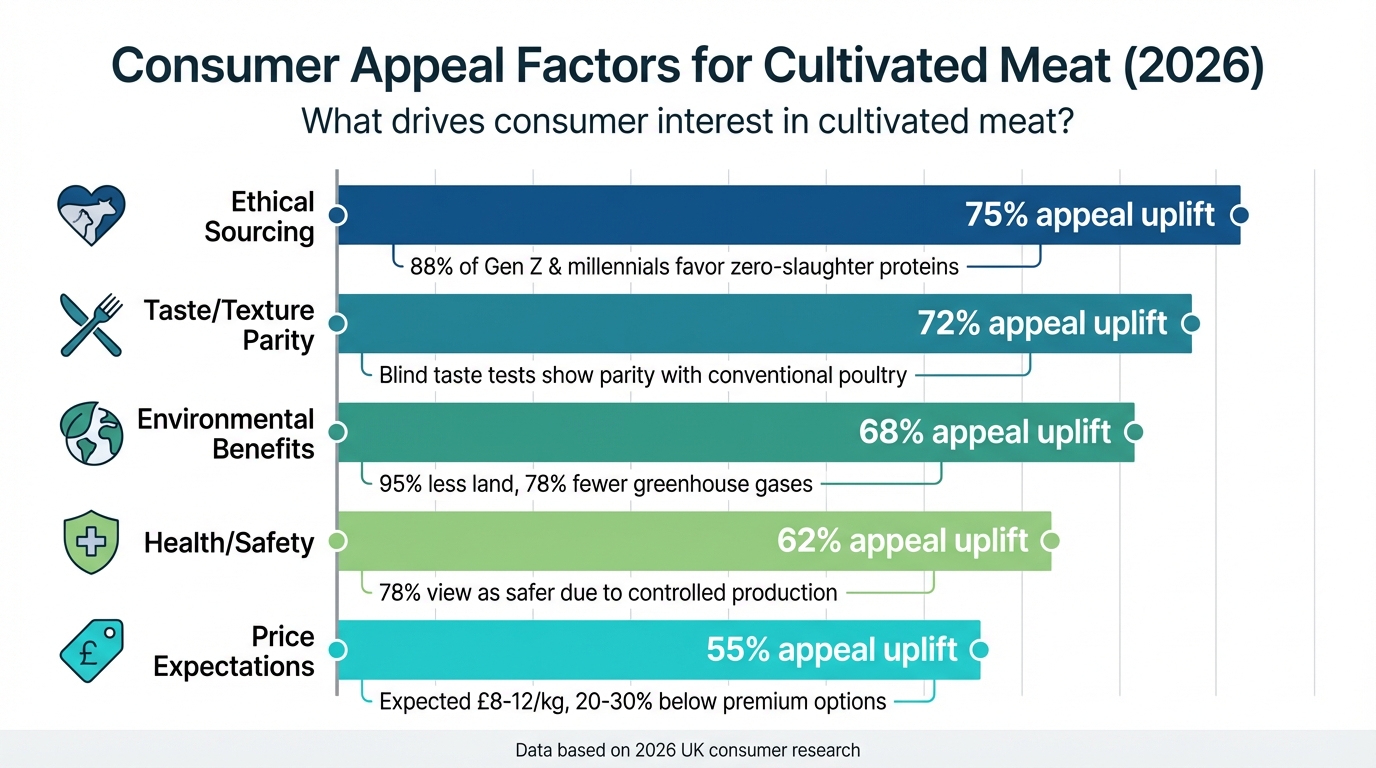
Top 5 Consumer Appeal Factors for Cultivated Meat in 2026
This section takes a closer look at the factors driving consumer interest in Cultivated Meat, using recent data to highlight how aspects like ethical sourcing and taste quality resonate with buyers.
Ethical sourcing, particularly focusing on animal welfare, stands out as a major driver, boosting consumer appeal by 75%. Among Gen Z and millennial shoppers, 88% express a preference for cruelty-free options [8][11]. The zero-slaughter promise of Cultivated Meat provides a clear and transparent alternative to traditional farming practices.
Environmental considerations also hold significant weight. The environmental benefits of Cultivated Meat lead to a 68% increase in appeal. With 95% less land required and 78% fewer greenhouse gases emitted compared to conventional meat, these metrics strongly influence decision-making. In fact, UK consumers show 82% greater interest when lifecycle analyses highlight these benefits [8][9].
Concerns about health and safety provide another key motivator, contributing a 62% uplift in appeal. Around 78% of consumers believe Cultivated Meat is safer due to the reduced risk of contamination often associated with factory farming [10][11]. Regulatory approvals in countries like the US and Singapore have further boosted trust, with confidence levels among informed UK consumers expected to hit 85% by 2026.
Table: Consumer Appeal Factors
The table below summarises the primary factors influencing consumer interest, along with their respective appeal boosts.
| Factor | Description | Appeal Uplift | Key Evidence |
|---|---|---|---|
| Ethical Sourcing | Focus on animal welfare and cruelty-free production | 75% | 88% of Gen Z and millennials favour zero-slaughter proteins [8][11] |
| Taste/Texture Parity | Comparable quality to traditional meat | 72% | Blind taste tests show parity between cultivated chicken and conventional poultry [9][11] |
| Environmental Benefits | Reduced emissions and land use | 68% | 95% less land and 78% fewer greenhouse gases compared to conventional meat [8][9] |
| Health/Safety | Lower contamination risks | 62% | 78% view it as safer due to controlled production methods [10][11] |
| Price Expectations | Competitive pricing | 55% | Consumers expect £8–12 per kg for beef mince, 20–30% below premium options [7][8][9] |
This data clearly highlights how ethical, environmental, and health factors are shaping consumer preferences, alongside expectations for taste and pricing.
Conclusion
Consumer feedback in 2026 paints a clear picture for the future of Cultivated Meat, with progress being shaped by education, taste, ethical values, and its environmental benefits. The market is expected to grow to an impressive £19.2 billion by 2030, bolstered by regulatory approvals in places like the US and Singapore, alongside growing curiosity among consumers[8].
Key drivers of interest remain ethical sourcing, improved animal welfare, and environmental advantages. However, meeting consumer expectations hinges on achieving taste and texture that rival traditional meat products[12][13].
That said, there are still hurdles to overcome. Low awareness and concerns about production methods influence 23% of potential buyers, underlining the importance of clear, science-backed education[14]. Platforms such as Cultivated Meat Shop play a crucial role in bridging this gap by offering transparent insights into production processes, showcasing sustainability benefits, and preparing UK consumers through waitlist access and exclusive product previews.
Building trust will require ongoing transparency, regulatory support, and accessible, reliable information. As production costs decrease and availability grows, informed early adopters will help pave the way for wider acceptance. Platforms like Cultivated Meat Shop remain vital in providing the knowledge needed to guide this transition. With consistent education and openness, Cultivated Meat can secure its place as a practical, ethical choice for UK consumers.
FAQs
When will Cultivated Meat be sold in UK shops?
Cultivated meat is expected to hit UK shop shelves around 2026 or 2027. However, it might take a bit longer for it to become broadly available, as regulatory hurdles and production challenges still need to be addressed.
How is cultivated meat approved for safety in the UK?
In the UK, cultivated meat must pass a rigorous safety approval process overseen by the Food Standards Agency (FSA). This is carried out through a regulatory sandbox programme, which carefully examines aspects such as safety, production techniques, and regulatory compliance. Only after meeting these strict standards will it be approved for commercial sale, with availability expected around 2027.
Will cultivated meat ever be as cheap as normal meat?
Yes, cultivated meat might reach price parity with conventional meat by the early 2030s. This shift is anticipated as production costs fall, driven by economies of scale, advancements in technology, and more efficient bioreactors. According to experts, the cost could drop to approximately £4.90 per pound for chicken, making it a more affordable choice for consumers.