Bioreactor cost is not just the tank price. If I were sizing up a system for cultivated meat, I’d look at five things first: size, material, control hardware, mixing and oxygen transfer, and scale plan.
Here’s the short version:
- A small 50-litre lab bioreactor may cost about US$7,000–US$9,000
- A large 5,000-litre+ system can reach US$300,000 or more
- Stainless steel often means more money up front, plus cleaning and sterilising systems
- Single-use units can cut the up-front spend, but you keep paying for disposable bags
- Better sensors and automation add cost, but they can cut labour and lower batch loss risk
- Scale choice matters a lot: one large vessel, several smaller ones, or a continuous setup can each shift cost in very different ways
- One model in the source article suggests continuous processing could cut CapEx and OpEx by 55% over 10 years
In other words: the cheapest bioreactor to buy is not always the lowest-cost system to run.
Dr. Marianne Ellis: Designing large-scale bioreactors and bioprocesses for cultivated meat
sbb-itb-c323ed3
Quick Comparison
| Cost factor | How it affects cost | What to watch |
|---|---|---|
| Size and working volume | Bigger vessels cost more to buy, install, heat, cool, and run | Space, utilities, cell density |
| Material and build | Stainless steel and single-use plastic bioreactors shift cost in different ways | Cleaning, disposables, contamination risk |
| Control and sensors | More automation means more spend up front | Calibration, labour, batch consistency |
| Mixing, oxygen and heat | Poor design can push power use and process problems up | Shear stress, oxygen demand, cooling load |
| Scale-up plan | Batch, scale-out, and continuous setups each change long-term cost | Risk spread, downtime, total output |
If I had to sum it up in one line, it would be this: bioreactor cost comes from bioreactor design choices that shape both purchase price and day-to-day running cost.
What Bioreactor Costs Actually Include
Bioreactor cost means the full installed system, not just the vessel. In Cultivated Meat production, costs can climb fast when a reactor has to handle high cell density and sterile operation.
There are two main cost buckets. Capital expenditure (CapEx) covers the upfront spend: the vessel, automation hardware, sensors, piping, gas lines, installation, and calibration. With stainless steel systems, you also need CIP and SIP infrastructure. Operating expenditure (OpEx) covers day-to-day running costs: culture media, energy, water, labour, recalibration, and replacement parts. A lot of these costs are shaped by design choices, which is exactly why the next five factors matter.
| Cost Category | Type | Examples |
|---|---|---|
| Vessel & hardware | CapEx | Stainless steel tanks, impellers, motor drives, single-use housing |
| Automation & control | CapEx | PLC systems, PID controllers, HMI touchscreens |
| Consumables | OpEx | Culture media, single-use bags, anti-foaming agents, gases (O₂, CO₂, N₂) |
| Utilities | OpEx | Electricity for heating/cooling, water for CIP/SIP, steam generation |
| Maintenance | OpEx | Sensor recalibration, seal replacements, filter changes, labour |
Three terms matter before getting into those five factors.
Working volume is the liquid volume inside the reactor. It is usually 70–80% of total vessel capacity [1][2], and it affects both vessel size and the amount of facility space you need.
Oxygen transfer describes how well oxygen gets to the cells. If transfer is poor, you may need a larger and more expensive reactor to get the same job done [2].
Process control means automated monitoring and adjustment of pH, temperature, and dissolved oxygen [1][2]. Better control adds to CapEx, but it can cut batch failure risk and reduce labour.
1. Bioreactor Size and Working Volume
Size is one of the clearest cost drivers in a bioreactor. As working volume goes up, the vessel gets more expensive, and so do gas transfer, heating, cooling, sterilisation, sensors, and control systems. In plain terms, size sets the tone for almost every other cost decision.
CapEx impact
Bigger vessels don't only cost more to purchase. They also cost more to fit into a facility. Commercial production often calls for reactors in the thousands of litres, which pushes upfront spend far above what you'd expect for lab or pilot systems[2].
There's also a practical trade-off here. Instead of buying one very large reactor, some producers use multiple 100–1,000 litre vessels. That can reduce upfront cost and lower technical risk at the same time[2]. It's a simpler path for teams that want room to scale without putting all their money into one giant system.
OpEx impact
Larger working volumes can bring down cost per kilogram in some settings. But that doesn't mean day-to-day running gets cheaper across the board. Bigger systems usually need more energy for temperature and process control, more media, and more labour for operation and maintenance.
Control also gets harder as volume climbs. At larger scales, oxygen, nutrient, and waste gradients are tougher to manage[2]. And when conditions drift across the vessel, process performance can drift with them.
High-density production
High-density production often targets cell densities above 1×10^7 cells/mL[2]. That points to what large systems can deliver, but it also shows how much capital is tied up in getting there. For many producers, a better route is to use smaller vessels and run them at high density, rather than commit early to massive infrastructure.
| Working Volume | Typical use |
|---|---|
| 50 litres | R&D and early development[1] |
| 100–1,000 litres | Scale-out facilities; lower capital expenditure path[2] |
| 1,000–5,000 litres | Pilot and industrial scale[1] |
| 5,000 litres+ | Large industrial systems[1] |
Once size is set, material and construction standard determine how expensive the vessel itself becomes.
2. Reactor Material and Construction Standard
Material choice is one of the main things that pushes bioreactor cost up or down. Stainless steel, single-use polymer systems, and glass each come with a different mix of upfront spend, running costs, and day-to-day risk. Then there’s the next layer: once you pick the material, the build standard starts to shape sterilisation needs, maintenance work, and the cost of replacement parts.
CapEx impact
Glass systems are usually the lowest-cost option. They’re most often used at bench-top and laboratory scale, usually around 3–50 litres [1].
As teams move into larger pilot and industrial volumes, stainless steel tends to become the standard choice [2]. Single-use systems can cut upfront spend, which sounds appealing at first. But at cultivated meat scale, the cost of sterile disposable bags often makes them uneconomic [2].
OpEx impact
Stainless steel systems bring repeat running costs for the water, energy, and cleaning chemicals needed for each sterilisation cycle [2]. Single-use systems flip that model. They reduce cleaning hassle, but replace it with a repeat purchasing burden for disposable bags.
For high-density Cultivated Meat production, build quality matters because it shapes contamination risk and batch consistency. Cultivated Meat cells do not have a cell wall, so they are more sensitive to physical stress than microbial cells. That makes construction details more than a box-ticking exercise.
A rough internal surface finish or poor weld quality can leave tiny crevices where contaminants can hide. And in this setting, one contamination event can wipe out a full batch. 316L stainless steel is a common industry standard for Cultivated Meat bioreactors because it offers corrosion resistance and performs well with hygienic cleaning agents [1].
Sensor durability matters as well. In-line sensors need to handle repeated sterilisation cycles without drifting out of calibration [2]. Internal geometry also plays a direct part in cell performance. The way a reactor is built changes how much shear stress cells face during mixing, which can affect viability and differentiation [2].
After material and build quality, the next big cost driver is the amount of control hardware the reactor needs.
3. Process Control and Instrumentation
After vessel design, control hardware is often the next big cost driver.
CapEx impact
Basic control systems are fairly low-cost. But once you move into industrial-scale units with full automation, sensor suites, and touchscreen control panels, costs can climb past $200,000. Add advanced spectroscopic systems for online, real-time monitoring, and the spend goes up again at the top end [1][2].
OpEx impact
In-line sensors come with a running cost. They need calibration and periodic replacement, which adds labour and maintenance spend. Offline sampling cuts back on hardware, but it creates more manual work and brings a higher contamination risk [2].
Effect on process consistency
The main variables to track are temperature, pH, dissolved oxygen, CO₂, glucose, biomass, and key metabolites [2]. Miss one of these, and the process can drift quietly in the background until the issue shows up in poor performance or lost batches.
In large vessels, one sensor reading often isn't enough. Conditions can vary from one part of the reactor to another, so sensor arrays placed at multiple points are often needed to map those gradients properly and give automated control systems data they can act on [2].
Relevance to high-density Cultivated Meat production
High-density Cultivated Meat cultures - generally defined as exceeding 1 × 10⁷ cells/mL - put much more strain on monitoring systems [2]. As cell density climbs, inhibitory metabolites such as ammonia and lactic acid build up faster. If instrumentation doesn't pick up those shifts in real time, cell viability can fall fast.
Even with stronger cell lines, the reactor still needs precise instrumentation to spot trouble early.
That control burden gets heavier when the reactor also has to handle mixing, oxygen transfer, and heat.
4. Mixing, Oxygen Transfer and Heat Management Design
Once control systems are sorted, the next big cost driver is how the reactor moves fluid, gets oxygen into the culture, and pulls heat back out.
In Cultivated Meat production, those three jobs have a direct effect on both CapEx and OpEx.
CapEx impact
The mixing system has a big say in reactor cost and build complexity. Stirred-tank reactors (STRs) are still the standard setup. They use mechanical impellers, which work well in many bioprocesses. But there’s a catch with Cultivated Meat: animal cells don’t have cell walls, so they’re much more prone to shear stress caused by turbulence. That means reactor design often has to lean towards low-shear impeller setups, or shift to air-lift reactors instead.
Air-lift reactors use controlled gas bubbling and don’t rely on moving parts. That can make them a better fit at larger scale. In fact, they start to look more attractive above 20,000 L, where mechanical stirring becomes harder to justify [2].
Heat management adds another cost layer. Large-scale, high-density cultures produce heat continuously, and that heat has to be removed to keep mammalian cells at 37°C [2]. In practice, that means adding cooling jackets and temperature control hardware, which pushes CapEx up [1].
OpEx impact
Running costs are heavily shaped by energy use. Mixing, aeration, and cooling all draw power, and that adds up fast at scale.
CIP and SIP also increase water and energy spend in stainless steel systems. Single-use systems avoid those cleaning steps, but the trade-off is the cost of disposable bags [1][2].
Effect on process consistency
If mixing is poor, the reactor can develop nutrient, oxygen, and temperature gradients. That’s a problem because cells in one part of the vessel may be seeing very different conditions from cells elsewhere.
You can improve uniformity by increasing impeller speed, but that also increases shear. Aeration runs into a similar trade-off: smaller bubbles can improve oxygen transfer, yet they can also damage cells [2].
That’s what makes scaling cultivated meat so tricky. Better transfer often means more stress on the cells.
Relevance to high-density Cultivated Meat production
At high cell density, these issues push costs up fast [2]. Oxygen demand climbs sharply, heat output goes up, and the risk of localised gradients increases with every jump in reactor volume.
These design decisions also shape whether a reactor can scale in an efficient way.
5. Scale-up Strategy and Fit for Purpose
Once a reactor can mix well, deliver enough oxygen and remove heat properly, the next big cost issue is scale. This is where a lot of projects either become financially workable or start getting expensive fast.
Scale strategy is one of the main drivers of bioreactor cost.
CapEx impact
There are two broad paths: scale up or scale out. Scale up means moving into larger and larger vessels. Scale out means running several smaller reactors at the same time.
On paper, bigger vessels can sound like the obvious move. In practice, once you get beyond several thousand litres, costs can climb quickly. You need more engineering to deal with gas exchange, heat transfer and shear stress. That pushes up upfront spend in a big way [2].
Scaling out can ease that initial CapEx burden and spread capital risk across more units. The catch is fairly simple: if you want multiple smaller reactors to run well, you usually need more automation behind the scenes [2].
There’s also the processing model itself. Switching from batch to continuous processing has been modelled to save 55% on both CapEx and OpEx over a 10-year period, while also cutting the vessel size needed for the same output [2]. That’s a big shift, not a minor tweak.
OpEx impact
Batch processing tends to cost more to run because it builds in downtime between runs. It also often needs larger vessels to meet production targets. Both factors push OpEx upwards [2].
Continuous and perfusion systems work differently. They keep the process at steady state, so there’s less idle time and less stop-start inefficiency. Even then, the main running costs don’t disappear. Media use and energy for sterilisation stay at the top of the list whatever route you choose [2].
Effect on process consistency
Batch cultures are variable by nature. Nutrients fall over time, while metabolites build up. That means conditions drift during the run, which makes control harder.
Continuous manufacturing keeps the system at steady state. That directly reduces gradient problems in oxygen, nutrients and temperature, which get tougher to manage as reactor size increases [2]. Put simply, what feels manageable in a small vessel can become a headache in a large one.
Before committing to large-scale CapEx, use 250 mL scale-down reactors to optimise conditions [2]. It’s a much cheaper place to learn what the cells actually need.
Relevance to high-density Cultivated Meat production
For Cultivated Meat, this gets even more specific. Many meat-relevant cells are anchorage-dependent, so they do not naturally lend themselves to large-scale production in a scalable bioreactor. To make that work, producers often need to adapt cells for suspension growth or use microcarriers [2].
That adaptation is not a side issue. It sits right at the centre of commercial-scale viability. In other words, scale is not just about vessel size. It is also about whether the cells can behave in a system that can be run at production level without costs getting out of hand. These choices drive the trade-offs shown in the table below.
Bioreactor Cost Trade-offs at a Glance
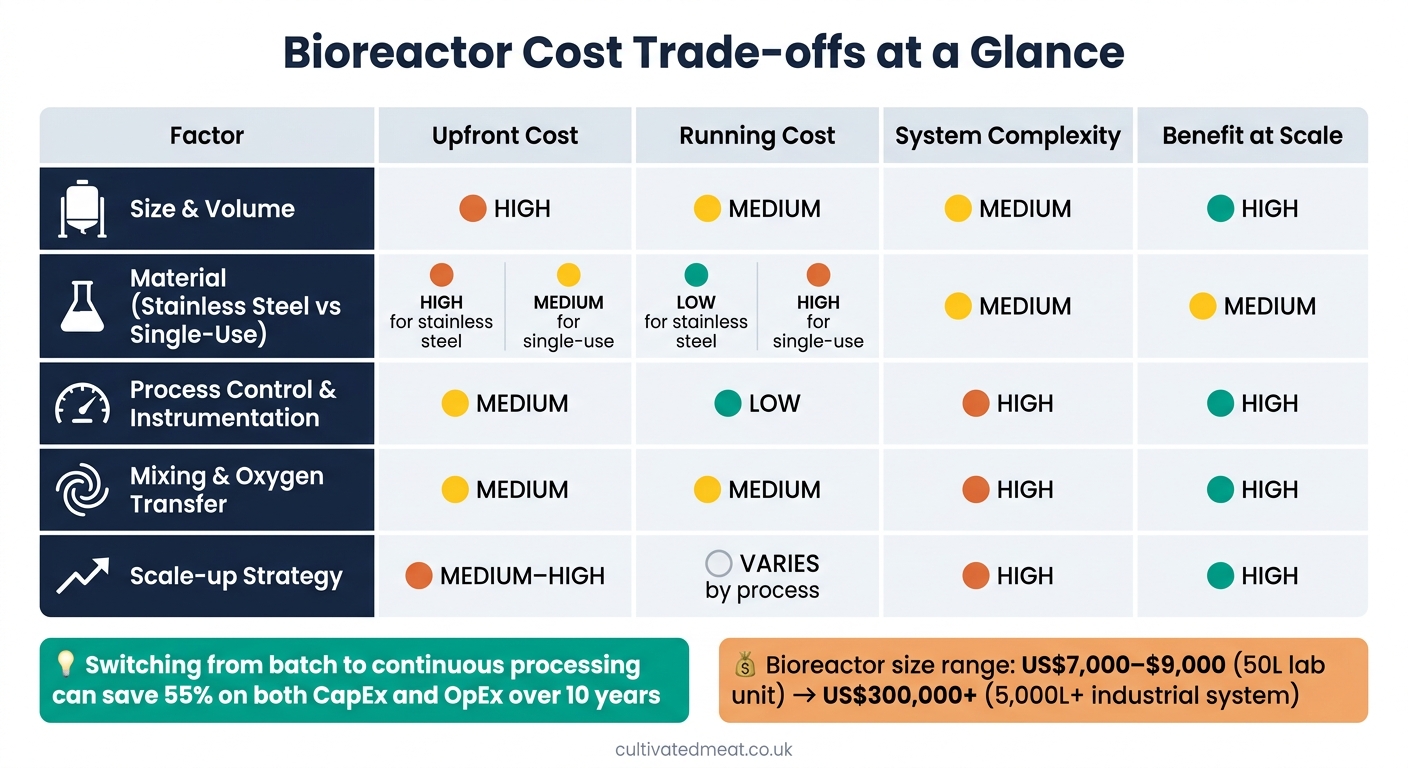
Bioreactor Cost Factors: CapEx vs OpEx Breakdown for Cultivated Meat
In high-density Cultivated Meat systems, cost is about more than the vessel price. Five factors shape the picture in different ways: upfront spend, day-to-day cost, and technical complexity. The table below puts those pressures next to each other.
Read this as a cost map, not a ranking.
| Factor | Upfront Cost | Running Cost | System Complexity | Benefit at Scale |
|---|---|---|---|---|
| 1. Size & Volume | High | Medium | Medium | High |
| 2. Material (stainless steel vs. single-use) | High (stainless steel) / Medium (single-use) | Low (stainless steel) / High (single-use) | Medium | Medium |
| 3. Process Control & Instrumentation | Medium | Low | High | High |
| 4. Mixing & Oxygen Transfer | Medium | Medium | High | High |
| 5. Scale-up Strategy | Medium–High | Varies by process | High | High |
A quick read of the table makes one thing clear: each cost driver bites in a different place. Bigger systems tend to demand more money upfront. Material choice shifts the balance between capital spend and repeat operating spend. Control systems add complexity, but they can tighten process consistency at scale.
Mixing and oxygen transfer sit in a similar camp. They don’t just add hardware cost; they also make the whole system harder to run well. And in dense cell culture, that matters. If mixing is poor or oxygen delivery falls short, performance can drop fast.
Scale-up strategy has the biggest long-term effect on total cost. That’s where process design can change the economics in a big way. Costs climb steeply as you move from lab work to industrial production, so early scale decisions have a long shadow. These choices are critical as the industry follows the roadmap for cultivated meat toward commercialization. One example stands out: switching from batch to continuous processing has been modelled to deliver savings of 55% on capital and operating expenses over a 10-year period [2].
The conclusion pulls these trade-offs together.
Conclusion
No single specification sets bioreactor cost. It comes down to five main choices: size, material, control, mixing, and scale-up strategy. And the main thing to watch is total cost, not just the purchase price.
The right bioreactor is the one that fits the process goal at the lowest total cost. You can use a cultivated meat cost estimator to model these variables. It needs to suit the cell line, keep sterility in place, and support steady growth without adding extra cost that the process doesn’t need. That’s why early design decisions carry so much weight.
Process choice can change both CapEx and OpEx in a big way over time. Smarter bioreactor design is one path to lower Cultivated Meat production costs.
For more educational articles on Cultivated Meat, visit Cultivated Meat Shop.
FAQs
Why is the vessel price only part of total bioreactor cost?
The vessel price is just one part of the total bioreactor cost. A big share of the spend comes from day-to-day running costs and what the site needs around the system.
That includes energy for heating, cooling, and oxygen circulation, along with cleaning and sterilisation systems and precise monitoring equipment. At Cultivated Meat Shop, we track how these factors shape affordability as the industry moves towards scalable, food-grade standards.
When is single-use cheaper than stainless steel?
Single-use bioreactors can cost less than stainless steel systems because they remove the need for expensive cleaning-in-place and sterilisation-in-place infrastructure. They can also reduce upfront capital spend, since they use less stainless steel, less piping and fewer sensors.
Because they arrive pre-sterilised, they can also shorten turnaround time and cut water and energy use. That said, the economics only work if waste is handled well and the price of food-safe disposable bags for Cultivated Meat stays under control.
Why can continuous processing reduce bioreactor costs?
Continuous processing can cut bioreactor costs because it avoids the downtime needed to clean and sterilise equipment between runs. Instead of stopping and starting, the system keeps going: mature cells are removed, fresh nutrients are fed in, and production carries on.
With real-time monitoring and cell retention devices, this setup can make production more efficient while lowering both capital and running costs. In fact, over 10 years, it can reduce those costs by as much as 55% compared with batch processing.