Sensors are transforming cultivated meat production by cutting costs and improving efficiency.
Here’s how:
- Real-time monitoring: Sensors track oxygen, pH, and nutrients in bioreactors, reducing waste and energy use.
- Lower media costs: Advanced tools optimise nutrient delivery, saving on the most expensive production component.
- Automation: Continuous data enables automated adjustments, reducing labour and errors.
- Cost reduction: A 2024 study showed production costs dropping to £10.70/kg, nearing organic chicken prices.
These advancements mean cultivated meat is getting closer to being affordable for everyday consumers in the UK.
Aniekan Esenam of Hamilton
The Main Cost Drivers in Cultivated Meat Production
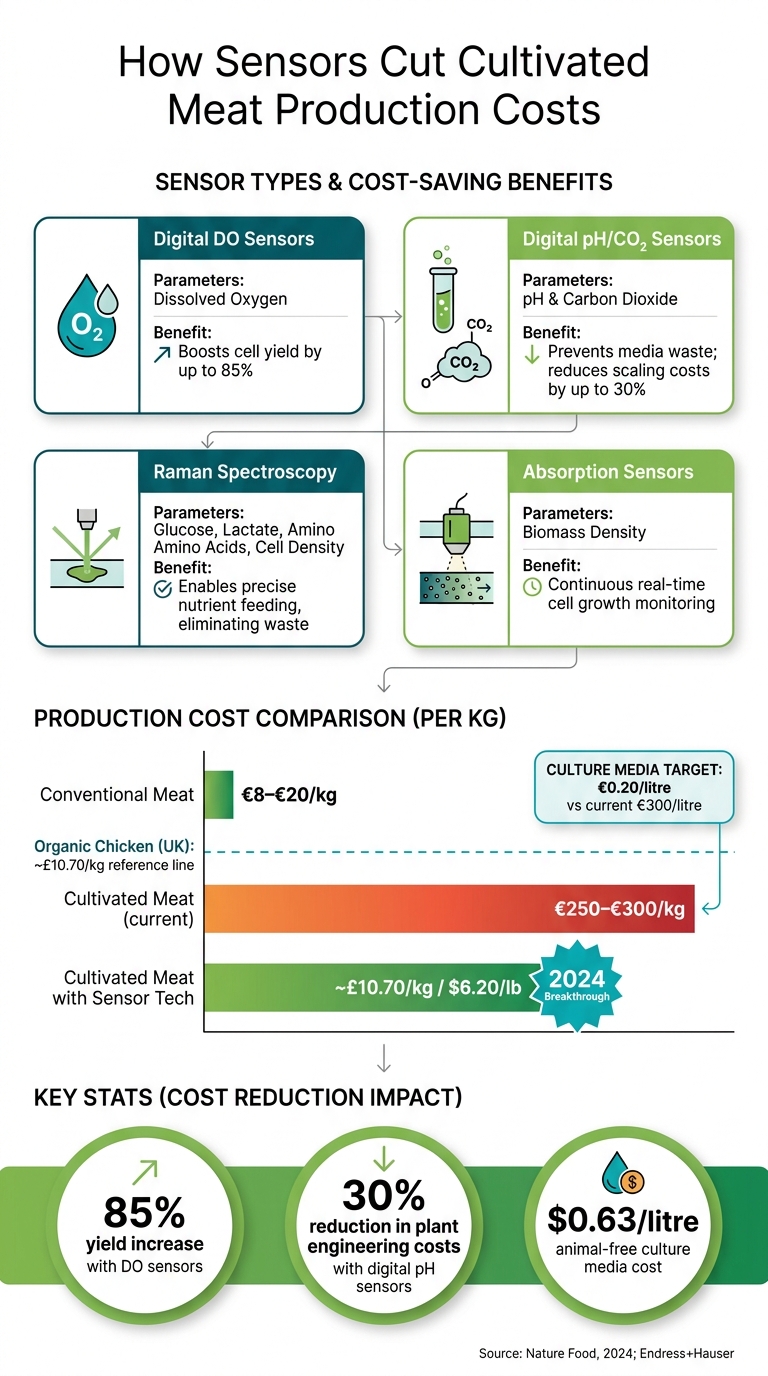
To understand how sensors can help reduce expenses, it’s important to first break down the key factors driving costs in cultivated meat production. Every stage of the process contributes to overall expenses, and current methods place cultivated meat at an estimated €250–€300 per kg. In contrast, conventional meat costs only about €8–€20 per kg [3].
Cell Culture Media: The Largest Cost Factor
Cell culture media, the nutrient-rich solution used to grow cells, is the biggest expense in cultivated meat production. At lab scale, growth factors alone – the proteins that signal cells to divide – can exceed €300 per litre [3]. These pharmaceutical-grade components significantly impact the total cost.
Adding to the challenge, inefficient monitoring can lead to wasted nutrients and the accumulation of byproducts that hinder cell growth, further driving up costs. To make cultivated meat viable, the industry aims to reduce media expenses to approximately €0.20 per litre at an industrial scale [3].
Energy Demands: Heating, Cooling, and Mixing
Bioreactors, the vessels where cells grow, are highly energy-intensive. They require constant power to maintain precise temperatures, continuous mixing to keep cells suspended, and gas sparging to ensure proper oxygenation [1]. Scaling up production – such as in a hypothetical 50,000-litre facility modelled in a 2024 Nature Food study – amplifies these energy requirements. Larger bioreactors also create challenges in evenly distributing nutrients and oxygen, reducing overall energy efficiency [3].
Labour and Manual Monitoring
Skilled technicians play a critical role in manually sampling and adjusting processes, but this reliance on human labour increases costs and introduces risks of error or contamination. Batch-based systems, where bioreactors are filled, run for one to three weeks, and then emptied and cleaned before the next cycle, are particularly labour-intensive [3].
As highlighted in the Nature Food study:
"Current production technologies result in low yields, leading to economic projections that prohibit cultivated meat scalability." [1]
Key Sensor Types and Their Role in Cutting Costs
Cultivated Meat vs Conventional Meat: Cost Breakdown & Sensor Savings
Production costs in cultivated meat bioreactors are often driven by media waste, energy inefficiency, and manual monitoring. Sensors provide targeted solutions to these issues. But which ones truly make an impact? Here are three key sensor types that address specific inefficiencies, helping to cut costs while improving overall production.
Dissolved Oxygen Sensors for Efficient Cell Growth
Monitoring dissolved oxygen (DO) is crucial during cell cultivation. Insufficient oxygen can starve cells, slowing growth, while excess oxygen can harm them. Inline digital optical DO sensors offer continuous tracking of oxygen levels, removing the need for manual sampling and reducing contamination risks [4]. By enabling real-time monitoring and automated oxygen control, these sensors have been shown to boost product yields by as much as 85% in mammalian cell cultures [4]. They also help producers optimise aeration and agitation, cutting down on energy costs. Maintaining the ideal bioreactor environment is equally important, which is where pH and CO₂ sensors come in.
pH and CO₂ Sensors for Stable Media Conditions
Cell culture media is a significant expense, and pH instability can lead to wasted batches. If pH levels drift outside the optimal range, cell growth slows, and the entire process may be compromised. Digital pH sensors, like those using Memosens inductive non-contact coupling technology, provide dependable readings even under challenging conditions, such as moisture and pressure in large-scale bioreactors [4]. Using the same sensor technology from pilot-scale to full-scale production ensures consistent measurements, saving time and money during scale-up. In fact, this approach can reduce plant engineering costs and timelines by up to 30% [4]. Additionally, optimising nutrient delivery - the focus of the next sensor type - further helps reduce waste.
Biomass and Metabolite Sensors for Smarter Feeding
Overfeeding leads to wasted growth media, while underfeeding stunts cell growth, both driving up costs. Biomass and metabolite sensors provide real-time insights into cellular activity to address this issue. Raman spectroscopy is a standout tool here: a single probe can monitor glucose, lactate, amino acids, and cell density, enabling precise nutrient delivery [4]. These insights feed directly into automated systems that adjust nutrient levels in real time, eliminating guesswork and reducing the costs associated with both overfeeding and underfeeding.
| Sensor Type | Parameters Monitored | Key Cost-Saving Benefit |
|---|---|---|
| Digital DO Sensors | Dissolved oxygen | Boosts yield by up to 85% [4] |
| Digital pH/CO₂ Sensors | pH, carbon dioxide | Prevents media waste; reduces scaling costs by up to 30% [4] |
| Raman Spectroscopy | Glucose, lactate, amino acids, cell density | Ensures precise feeding, avoiding waste [4] |
| Absorption Sensors | Biomass density | Enables continuous monitoring of cell growth [4] |
These sensors are the foundation of a more efficient, data-driven production process, ensuring minimal waste and maximum use of every litre of media.
sbb-itb-c323ed3
Using Sensor Data to Drive Efficiency
Sensor data plays a key role in making better decisions. Its real power lies in how it’s collected, used, and applied to improve production processes from start to finish.
Real-Time Monitoring vs. Manual Sampling
Traditional bioreactor management depends on manual sampling. This involves a technician physically opening the system, taking a sample, and sending it to a lab for analysis. This method not only delays action but also increases the risk of contamination.
Inline sensors completely transform this process. They provide continuous, round-the-clock data while maintaining sterility. As Endress+Hauser explains:
"Daily offline analysis in the laboratory increases contamination risk, carries higher operational expenses, and does not provide 24/7 understanding of cell metabolism." [5]
The speed of response is a game-changer. With real-time data, issues can be identified and resolved immediately instead of after the damage is done. This uninterrupted data stream also sets the stage for automated solutions.
Automated Feedback Control Systems
Once live sensor data is integrated into the system, automation becomes the next logical step. Instead of relying on a technician to interpret data and manually adjust settings, automated feedback loops take over, making adjustments instantly.
For instance, automated systems can fine-tune nutrient levels as soon as a drop is detected. Similarly, sensors can immediately correct fluctuations in oxygen or pH levels. This type of closed-loop control ensures consistent, high-quality production at scale, while also reducing the labour and resources needed for manual interventions.
But the benefits of sensor data don’t stop at real-time adjustments. It also opens the door to predictive insights.
Predictive Analytics and Process Optimisation
Sensor data isn’t just reactive - it’s predictive. The detailed information collected by inline sensors allows producers to create process models, effectively digital blueprints that map how cells behave under various conditions.
These models are incredibly useful during scale-up, a notoriously expensive and unpredictable phase in cultivated meat production. By leveraging existing sensor data, producers can predict optimal conditions, cutting out much of the trial-and-error process. According to Endress+Hauser, professional sensor automation can reduce plant engineering costs and timelines by up to 30% [5].
A striking example of this comes from research published in Nature Food in August 2024. Scientists from The Hebrew University of Jerusalem and Believer Meats demonstrated the use of continuous perfusion manufacturing, supported by real-time monitoring of glucose, lactate, and ammonium levels, to sustain high-density chicken cell cultures of 130 × 10⁶ cells per ml for over 20 days. Their analysis suggested that this approach could lower the cost of cultivated chicken to approximately $6.20 per lb (around £4.90 per lb) in a 50,000-litre facility [1].
From Lower Production Costs to More Affordable Products
Advancements like fewer batch failures, better use of media, and higher cell densities are driving down production costs. These innovations in sensor technology are laying the groundwork for making cultivated meat more affordable and closing the price gap with conventional meat. Many UK consumers are now wondering how quickly these savings will translate into lower prices at the supermarket.
Bridging the Cost Gap with Conventional Meat
The numbers are starting to show promise. A study published in Nature Food in August 2024, conducted by scientists at The Hebrew University of Jerusalem and Believer Meats, estimated that using continuous perfusion manufacturing and an animal-free culture medium could produce cultivated chicken for about $6.20 per lb (approximately £4.85 per lb or £10.70 per kg) at a 50,000-litre scale [1][2]. This cost is edging closer to the price of premium organic chicken found in UK supermarkets.
"By using TFF, a continuous process and an animal‐free serum, cultivated chicken can be produced for $6.20 (€5.60) per pound." - Augustus Bambridge‐Sutton, FoodNavigator [2]
A significant factor in this cost reduction is the innovation in culture media. Animal-free media, which replaces expensive proteins like albumin with alternatives such as hydroxypropyl β-cyclodextrin and methylcellulose, now costs as little as $0.63 per litre [1]. Since culture media typically accounts for 40–60% of total production costs, even small savings in this area can have a substantial impact on the final product price [2]. Supporting this progress, the UK government announced £15 million in funding for the National Alternative Protein Innovation Hub (NAPIC) in August 2024. This funding aims to speed up the transition from lab-scale production to commercially available cultivated meat [2].
How Cultivated Meat Shop Keeps Consumers Informed

As production costs drop, consumers benefit from clear and transparent updates provided by platforms like Cultivated Meat Shop. This is the first consumer-focused platform dedicated to cultivated meat, offering easy-to-understand explanations of technological advancements, including cost reductions.
Although cultivated meat products are not yet on sale in the UK, Cultivated Meat Shop provides previews of upcoming products, educational articles, and waitlist sign-ups. This allows interested consumers to stay informed about industry progress and be among the first to know when these products hit the shelves. With the price gap between cultivated and conventional meat narrowing, having a reliable and up-to-date resource helps people understand what’s coming and why it matters.
Conclusion: Why Sensors Matter for the Future of Cultivated Meat
Sensors play a critical role in cultivated meat production by enabling continuous perfusion and real-time metabolite monitoring. These advancements help improve efficiency while reducing costs [1].
Research published in Nature Food highlights that sensor-driven perfusion can extend the lifespan of cultures and support strong biomass yields [1]. By tackling key cost challenges, advanced sensors are helping cultivated meat move closer to becoming a practical alternative to traditional meat.
"The cost of cultivated chicken can drop to within the range of organic chicken at US$6.2 lb⁻¹ by using perfusion technology." - Nature Food [1]
These technological improvements not only enhance production processes but also make cultivated meat more affordable for consumers. While the technology is still evolving, its potential to reshape the meat industry is undeniable.
FAQs
Which sensors cut cultivated meat costs the most?
Advanced sensors are playing a big role in reducing the cost of producing cultivated meat. They make it possible to monitor processes in real time and automate key steps. For instance, Raman spectroscopy allows inline measurement of important nutrients like glucose and lactate, while capacitance sensors keep track of viable cell density. Additionally, automated sensors for pH, temperature, and dissolved oxygen ensure optimal growth conditions throughout production.
For a closer look at developments in cultivated meat, head over to Cultivated Meat Shop and learn more about this fascinating food innovation.
How does real-time sensing reduce media waste?
Real-time sensing helps cut down on media waste by swapping out rigid feeding schedules for automated, responsive nutrient delivery. Using sensors to track critical factors such as glucose, pH levels, and lactate, AI systems can deliver nutrients exactly when they're needed. This approach avoids overfeeding, keeps culture conditions ideal, and lowers the risk of batch failures. The result? A more efficient use of expensive media in the Cultivated Meat production process.
When will these savings reach UK supermarket prices?
Experts forecast that cultivated meat could match the cost of conventional meat by 2030, with prices estimated to fall between £4.30 and £10.00 per kilogramme. This price drop is being fuelled by advancements such as continuous perfusion bioreactors, the use of food-grade equipment, and the development of animal-free growth media. Cultivated Meat Shop regularly shares updates on these breakthroughs as the industry moves closer to bringing this sustainable alternative to supermarket shelves across the UK.