Cultivated meat, grown from animal cells rather than farmed livestock, could drastically reduce the environmental footprint of meat production. Traditional livestock farming contributes up to 19.4% of global greenhouse gas emissions, uses 83% of agricultural land, and is a major source of methane and nutrient pollution. Cultivated meat offers a promising alternative, with the potential to:
- Cut greenhouse gas emissions by up to 92% (when powered by renewable energy).
- Reduce global agricultural land use by 83%, freeing space for reforestation and biodiversity restoration.
- Lower air pollution and nutrient runoff by eliminating manure and reducing fertiliser use.
However, challenges remain. Current production is energy-intensive, reliant on costly growth mediums, and limited to small-scale facilities. Scaling up requires cleaner energy sources, lower costs, and more efficient processes. With investment and innovation, cultivated meat could transform global food systems while addressing climate goals.
Environmental Impact Comparison: Cultivated Meat vs Conventional Meat
How lab-grown meat could help the climate - On the Green Fence
Greenhouse Gas Emissions: Cultivated Meat vs Conventional Meat
Comparing greenhouse gas emissions from Cultivated Meat and conventional meat largely depends on the energy source driving production.
Life Cycle Assessments and Emission Reductions
When renewable energy powers the process, life cycle assessments show that Cultivated Meat could cut greenhouse gas emissions by 40–95% [2]. Unlike conventional meat, which releases methane and nitrous oxide from digestion and manure, emissions from Cultivated Meat mainly stem from the energy used for bioreactors and growth mediums [2][3].
Traditional beef production emits large amounts of methane (CH₄) and nitrous oxide (N₂O) due to fermentation and waste management. In contrast, Cultivated Meat's emissions are dominated by carbon dioxide (CO₂) from industrial energy use [2][3]. Pelle Sinke, a researcher at CE Delft, highlights this distinction:
Greenhouse gas profiles are different, being mostly CO₂ for CM and more CH₄ and N₂O for conventional meats [7].
However, the environmental benefits of Cultivated Meat could diminish significantly if refined growth mediums are used. Edward S. Spang, Associate Professor at UC Davis, cautions:
The environmental impact of near-term ACBM production has the potential to be significantly higher than beef if a highly refined growth medium is utilized [6].
This underscores the importance of careful production choices.
Carbon Footprint Comparisons
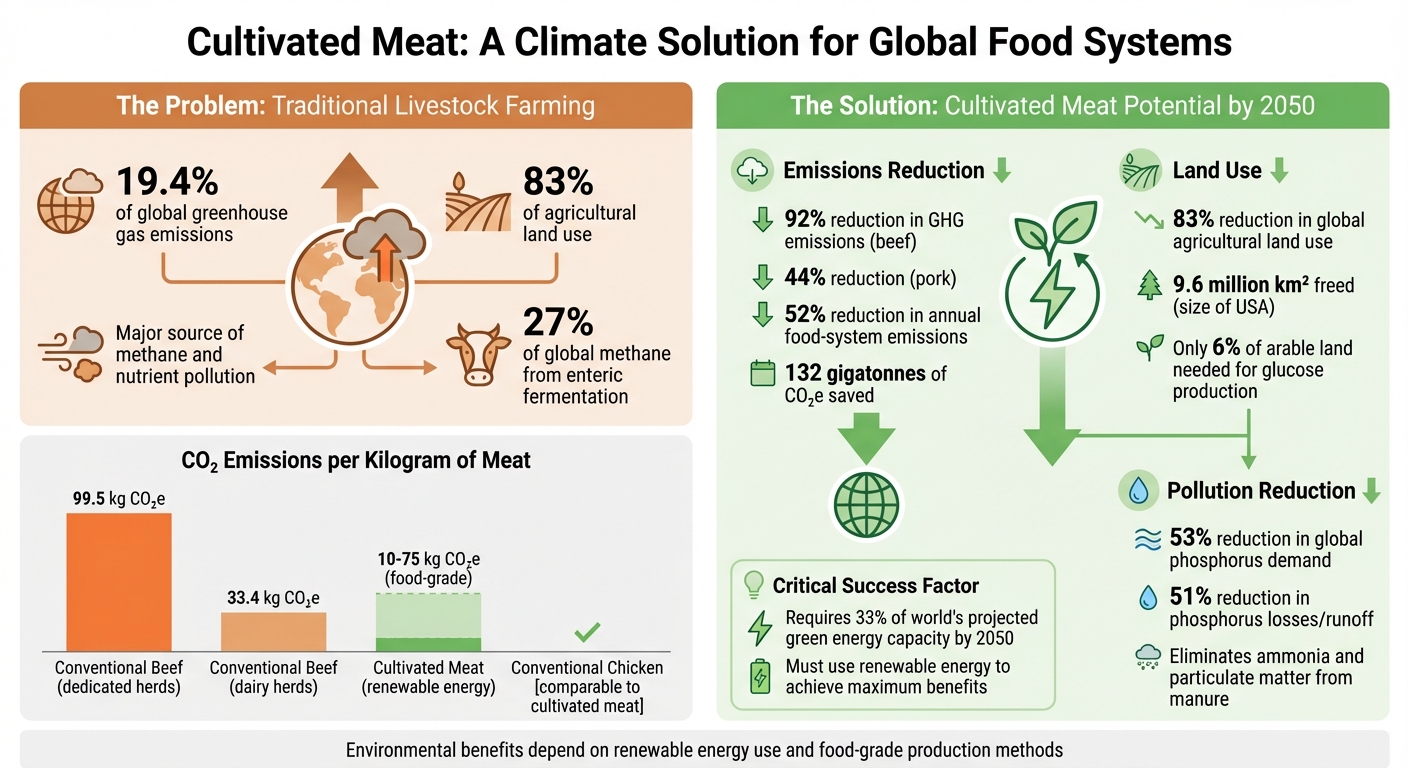
Life cycle assessments also allow for direct carbon footprint comparisons. When renewable energy is utilised, the difference becomes clear. Conventional beef from dedicated herds produces an average of 99.5 kg of CO₂e per kilogramme of meat, while beef from dairy herds averages 33.4 kg CO₂e [6]. Cultivated Meat, when powered by renewable energy, has a much smaller carbon footprint.
Pelle Sinke elaborates:
Using renewable energy, the carbon footprint [of cultivated meat] is lower than beef and pork and comparable to the ambitious benchmark of chicken [2].
A global shift to Cultivated Meat by 2050 could slash annual food-system greenhouse gas emissions by 52%, potentially saving 132 gigatonnes of CO₂-equivalent [4][8]. However, achieving these reductions would require about 33% of the world's projected green energy capacity [8]. This makes decarbonising energy grids a critical factor in realising Cultivated Meat's climate potential.
Land Use and Biodiversity Benefits
Cultivated meat is transforming how we think about land use by removing the need for livestock in meat production. This shift has the potential to free up enormous tracts of land currently used for livestock farming, opening doors for habitat restoration and carbon capture.
Land Savings Across Meat Types
The land-saving potential of cultivated meat is staggering. If fully adopted by 2050, global agricultural land use could drop by 83% [4]. To put that into perspective, this would free up around 9.6 million km² - an area comparable to the size of the United States - for purposes like reforestation and restoring natural habitats [4]. The key lies in eliminating the extensive pasturelands required for livestock, which currently make up 84% of all agricultural land. In contrast, producing the glucose needed for cultivated meat would only use about 6% of total arable land [4]. The result? A massive opportunity to rewild landscapes and revive ecosystems.
Reforestation and Carbon Capture Opportunities
The land freed by transitioning to cultivated meat production could significantly boost rewilding efforts and carbon capture. With animal agriculture taking up 83% of agricultural land globally and driving biodiversity loss [2], scaling back livestock farming could be a game-changer. Pelle Sinke and his team highlight this potential:
Governments should consider this emerging industry's increased renewable energy demand and the sustainability potential of freed-up agricultural land [2].
Brazil offers a real-world example of what this transformation could look like. According to a November 2023 McKinsey report, Brazil pledged to restore 15 million hectares of degraded pasturelands by 2030. By the report's release, 10 million hectares had already been restored, thanks to public–private partnerships and integrated farming systems [9]. This approach not only supports crop production but also sets the stage for reforestation projects that capture carbon and revitalise habitats. It’s a model that could inspire similar efforts worldwide.
sbb-itb-c323ed3
Air and Nutrient Pollution Reductions
Beyond its role in reducing land use and carbon emissions, Cultivated Meat offers another key advantage: it significantly lessens its impact on air quality and water systems.
Air Pollution Reductions
Conventional livestock farming is a major contributor to air pollution, with more than a third of all human-related nitrogen emissions coming from this sector [7][10]. Ammonia and fine particulate matter from animal manure are some of the main culprits behind declining air quality. In contrast, Cultivated Meat production operates in enclosed systems, which helps prevent the release of these harmful pollutants. This controlled environment also reduces the reliance on fertilisers, cutting down the need for large-scale crop farming [7].
"Nitrogen-related and air pollution emissions of CM are also lower because of this efficiency."
- Sinke et al., The International Journal of Life Cycle Assessment [7]
Methane emissions are another significant issue tied to traditional livestock farming. Enteric fermentation in ruminants alone accounts for 27% of global methane emissions caused by human activity [7]. Livestock farming also releases a mix of methane, nitrous oxide, and ammonia, all of which contribute to environmental degradation. Cultivated Meat eliminates these biological emission sources entirely. Its overall environmental impact largely depends on the energy sources used to power production facilities [7][11].
These improvements in air pollution also pave the way for better water quality, thanks to reduced nutrient runoff.
Nutrient Runoff and Water Quality
One of the biggest challenges in agriculture is nutrient pollution, particularly from manure runoff. Conventional livestock farming releases excess nitrogen and phosphorus into waterways, disrupting ecosystems and degrading water quality [7][6]. Cultivated Meat production eliminates the need for manure, directly addressing this issue.
A shift to Cultivated Meat could reduce global phosphorus demand by 53% by 2050 while cutting phosphorus losses - such as agricultural runoff - by 51% [4]. Currently, around 47% of phosphorus loss comes from agricultural runoff and livestock waste [4]. By reducing nutrient runoff, Cultivated Meat helps alleviate the environmental strain on water ecosystems, contributing to healthier waterways and more balanced nutrient cycles.
Scalability Challenges and Future Directions
Cultivated Meat holds a lot of promise, but scaling up production to meet global demand is no small feat. To move forward, the industry must tackle technical hurdles and shift towards cleaner energy solutions. Streamlining production processes will be critical to making this vision a reality.
Current Production Challenges
Right now, producing Cultivated Meat is energy-intensive, as industrial systems take over what would normally be biological processes. If the world were to fully transition to Cultivated Meat by 2050, energy demand across food systems could rise by an estimated 69–83% [4].
One of the biggest cost drivers is the growth media. Currently, these media are incredibly expensive, costing hundreds of pounds per litre due to the use of pricey recombinant proteins and amino acids. For commercial viability, costs need to drop significantly - ideally to about £1 per litre [1]. To put this into perspective, cultured fat production in 2020 cost around £11,000 per kilogramme. The goal is to reduce this to £4.50 per kilogramme by 2030 [1].
Most production facilities today are small-scale, operating at laboratory or pilot levels. For example, Eat Just has demonstration plants with reactors holding 3,500 and 6,000 litres. They’re planning larger commercial facilities with capacities of up to 250,000 litres [5]. Similarly, Upside Foods runs a pilot facility capable of producing 22,680 kilogrammes annually but aims to scale up to millions of kilogrammes in the future [5]. This gap between current production and the scale needed for commercial success highlights how early-stage this industry still is. Unlike conventional meat, which benefits from well-established supply chains, Cultivated Meat has a long way to go before it can compete on the same level. Breaking down these production barriers is essential to unlocking the environmental advantages discussed earlier.
Renewable Energy and Future Scaling
A major part of overcoming these challenges lies in embracing renewable energy. Cultivated Meat’s potential to be a sustainable alternative hinges on powering its facilities with clean energy sources.
"While CM production and its upstream supply chain are energy-intensive, using renewable energy can ensure that it is a sustainable alternative to all conventional meats." - Pelle Sinke, Researcher, CE Delft [2]
With renewable energy, Cultivated Meat could slash the carbon footprint of beef by up to 92%, pork by 44%, and remain competitive with chicken [12]. Without this shift, however, the technology risks generating more emissions than the conventional meats it seeks to replace. That’s why co-locating production facilities with renewable energy sources, like wind farms or solar installations, is so important for the industry’s green credentials.
Another key factor is transitioning to food-grade ingredients instead of relying on expensive pharmaceutical-grade inputs. Food-grade production methods could reduce emissions to between 10 and 75 kilogrammes of CO₂e per kilogramme of meat, compared to the 250 to 1,000 kilogrammes produced by pharmaceutical-grade processes [5]. According to Peter Verstrate, COO of Mosa Meat, we could see Cultivated Meat on the market within the next decade [1].
Conclusion
Research indicates that replacing traditional livestock farming with this technology could slash annual greenhouse gas emissions by 52%, reduce land use by 83%, and cut global phosphorus demand by 53% [4]. Unlike conventional meat production - which releases methane and nitrous oxide from animals and manure - Cultivated Meat produces mainly carbon dioxide from energy use, making decarbonisation efforts more straightforward.
The climate benefits are particularly striking when production facilities rely on renewable energy. In such scenarios, studies suggest that Cultivated Meat's carbon footprint is significantly lower than conventional beef and pork and roughly on par with chicken [2]. Moreover, it is nearly three times more efficient than chicken at converting crops into meat. This efficiency could free up vast areas of land previously used for livestock, enabling reforestation and natural carbon capture. These environmental advantages highlight the potential of Cultivated Meat, even as production challenges remain.
Research also confirms that Cultivated Meat outperforms traditional meat on metrics like land use, air pollution, and nitrogen emissions [2].
However, realising these benefits hinges on overcoming production hurdles and scaling up renewable energy use. Tackling these obstacles is key to unlocking the long-term environmental gains this technology promises. While the industry is still in its infancy, regulatory approvals in regions such as Singapore, Israel, the United States, and Australia [1] mark a significant step towards commercialisation.
For those keen to stay informed, Cultivated Meat Shop offers valuable insights into this emerging sector. From product updates to the latest sustainability research, the platform explores how real meat grown from cells - not slaughter - could transform our approach to food and the environment.
FAQs
What impact does cultivated meat have on greenhouse gas emissions compared to traditional meat?
Cultivated meat could play a major role in cutting greenhouse gas emissions when compared to traditional meat production. One key reason is its efficiency - it's nearly three times better at turning crops into meat. This means fewer emissions tied to raising animals for food.
Looking ahead to 2050, adopting cultivated meat on a global scale could potentially slash greenhouse gas emissions by about 52%. This dramatic reduction stems from using less land and employing more efficient production processes, positioning it as a promising alternative to conventional meat farming.
What challenges need to be overcome to scale up cultivated meat production?
Scaling up the production of cultivated meat comes with its fair share of challenges, particularly in the areas of technology, cost, and sustainability. One of the biggest obstacles is achieving large-scale efficiency while keeping costs manageable. To make cultivated meat more accessible and affordable, improvements are needed in bioreactor design, resource allocation, and energy consumption.
On the sustainability front, cultivated meat has the potential to dramatically cut down on land use and greenhouse gas emissions. However, scaling up production requires a lot of energy and relies on certain critical materials, some of which are scarce. Shifting to renewable energy and addressing these material constraints will be crucial for ensuring its long-term success.
Tackling these issues will depend on continuous advancements in technology, increased investment in renewable energy, and supportive government policies to make cultivated meat a practical and sustainable alternative to traditional meat.
How does cultivated meat support biodiversity and reforestation?
Cultivated meat has the potential to make a big difference in protecting biodiversity and encouraging reforestation by drastically reducing the land required for traditional livestock farming. Research indicates that it could decrease land use by as much as 83% compared to conventional meat production. This means large areas of land could be freed up for reforestation or the restoration of natural habitats.
This change also aligns with climate goals by cutting greenhouse gas emissions tied to both deforestation and livestock farming. Restored forests play a crucial role in absorbing carbon and creating essential ecosystems for wildlife, helping to combat biodiversity loss and meet global conservation targets. By easing environmental pressures, cultivated meat offers a promising way forward for healthier ecosystems and a greener planet.