Mark Post introduced the world’s first lab-grown burger on 5 August 2013 in London. This burger, created using cow cells, cost £250,000 and took months to develop. It wasn’t just a meal - it was a proof of concept for cultivated meat, a method of producing real meat without slaughtering animals.
Since then, the industry has grown massively. More than 160 companies are now working on cultivated meat, backed by over $2 billion in funding. Costs have dropped dramatically, from £250,000 per burger to around £29 per kilogram in 2026. Mark Post also co-founded Mosa Meat, a company focused on making cultivated beef available to consumers.
This innovation addresses challenges like reducing greenhouse gas emissions and ethical concerns linked to livestock farming. Though scaling production and improving taste remain challenges, cultivated meat is no longer an experiment - it’s shaping the future of food.
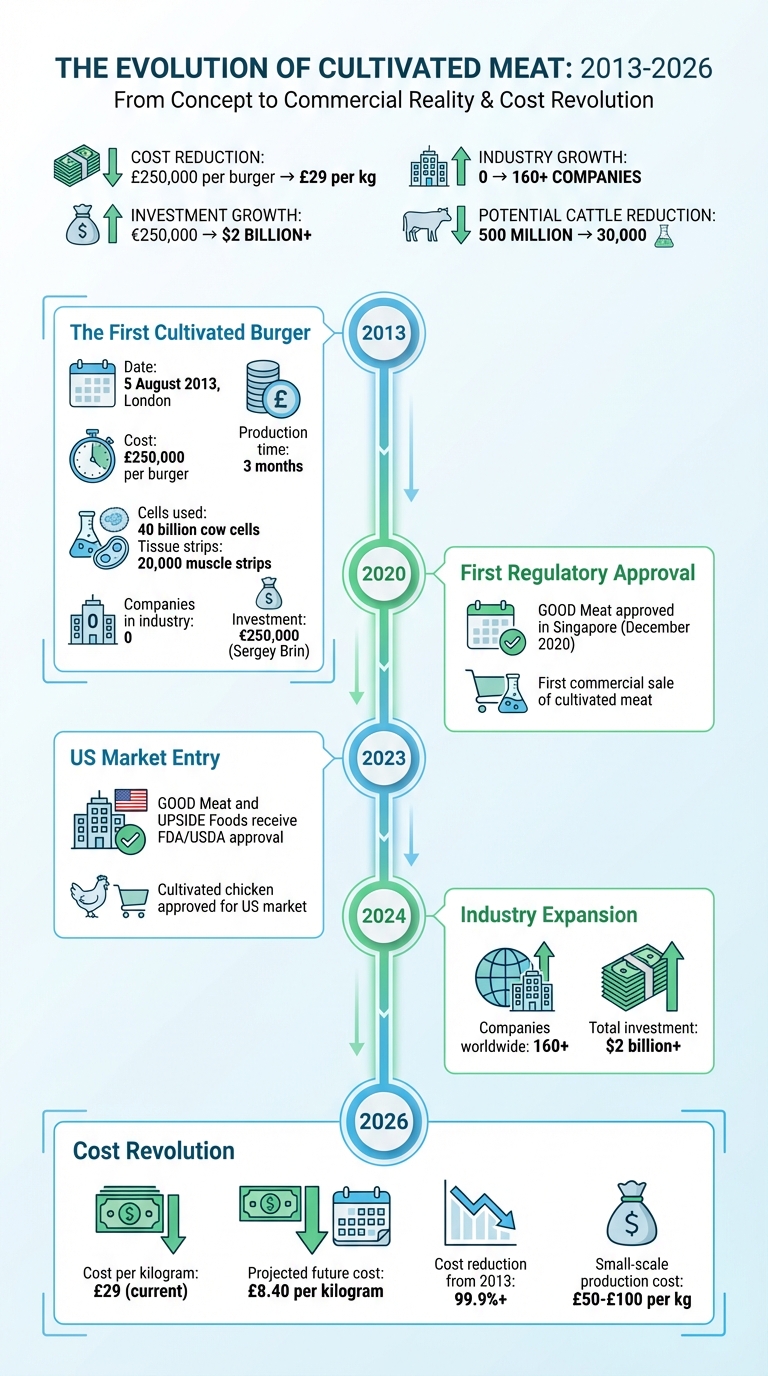
Evolution of Cultivated Meat: From First Burger to Global Industry (2013-2026)
Mark Post's Path to Cultivated Meat
Academic and Professional Background
Mark Post's journey began far from the world of food production. He earned a medical degree from Utrecht University in 1982 and later completed a PhD in Pulmonary Pharmacology in 1989 [1]. His academic career took him to renowned institutions like Harvard Medical School and Dartmouth Medical School before he returned to the Netherlands in 2002, where he held professorships at Maastricht University and Eindhoven University of Technology [1]. Since 2004, he has served as Chair of Physiology and Vice Dean of Biomedical Technology at Maastricht University [1].
Post’s work in angiogenesis - the process of forming new blood vessels - and tissue engineering became pivotal. While these fields were initially focused on regenerative medicine, they provided the technical foundation for cultivated meat. His expertise with cell culture techniques and various bioreactor designs, originally designed for growing replacement tissues, became instrumental in this new endeavour [2].
Interest in Food Solutions
With years of experience in tissue engineering, Post shifted his focus to global food challenges. He recognised the environmental strain caused by traditional meat production, which contributes 15% of global greenhouse gas emissions [4].
"If we refine existing methods into something that is very elegant and useful for the planet and for people, then I'll be perfectly happy." [4]
Post envisioned cultivated meat as a way to revolutionise the meat industry. He estimated that transitioning to this method could drastically reduce the global cattle population from 0.5 billion to just 30,000 [1]. Reflecting his belief in the need for change, he stated:
"There is no future for traditional meat" [4]
Determined to make this vision a reality, Post aimed to create real meat without the ethical and environmental downsides of conventional livestock farming. His breakthrough came when Sergey Brin, co-founder of Google, provided €250,000 in funding to develop the first proof-of-concept burger [1][4]. This financial backing allowed Post to move beyond theoretical work, proving that cultivated meat could address global food challenges. From there, he focused on turning these innovations into a viable food product.
sbb-itb-c323ed3
Creating the First Cultivated Burger
From Stem Cells to Edible Meat
Mark Post and his team made history by turning stem cells into an edible burger, marking a major step in redefining meat production. The process started with a small biopsy from a living cow, which provided myosatellite cells - specialised muscle stem cells responsible for repairing and regenerating muscle tissue. These cells were then placed in a nutrient-rich medium containing growth factors to encourage cell division. To support this process, pharmaceutical-grade calf serum was used to deliver the biological signals needed for the cells to multiply. Over seven to nine weeks, the cells multiplied and began forming muscle tissue. To aid this development, the team used a bioreactor equipped with custom-designed anchor points that applied tension, essentially "exercising" the cells to stimulate tissue growth [6][1].
Once the cells had grown sufficiently, the next step was to assemble them into a more complex, three-dimensional structure.
Tissue Formation and Enhancements
To create a realistic meat structure, the team seeded the cells onto an alginate gel scaffold made from seaweed. This scaffold helped the cells attach and organise into a cohesive form. In total, around 20,000 strips of cultured muscle tissue - amounting to roughly 40 billion cow cells - were combined to create a single five-ounce burger patty. Since the cultivated muscle lacked natural blood and fat, it appeared pale. To address this, the team added saffron and beet juice for a more realistic red colour. Breadcrumbs and a binder were also incorporated to improve the texture and overall mouthfeel [6].
With the burger taking shape, attention turned to the efficiency and cost of the production process.
Time and Cost of Production
Producing the first cultivated burger took three months from start to finish and came with a hefty price tag of approximately £250,000. This high cost reflected the labour-intensive nature of the process and the expense of the growth media.
Mark Post remarked, "It took about three months to produce, 'which is faster than [raising] a cow.'" [6]
While the process was groundbreaking, scaling it for commercial production presented significant challenges. Post estimated that with 2013 technology, the cost could eventually drop to $70 per kilogram. The first burger demonstrated that creating real meat from cells was possible - the next hurdle was finding a way to make it affordable and accessible [6].
The 2013 Debut
The London Launch Event
On 5 August 2013, Dr Mark Post introduced the world to the first-ever Cultivated Meat burger during a press conference in London. This groundbreaking moment demonstrated that producing real meat from cells was no longer just an idea - it was a reality. Chef Richard McGeown prepared the burger live in front of an international audience, and two volunteers, Austrian food researcher Hanni Rützler and food writer Josh Schonwald, tasted it on camera [7].
The event also revealed the financial force behind the project: Sergey Brin, Google's co-founder, who had contributed £250,000 to fund the research [7]. Brin highlighted the urgency of addressing the challenges posed by traditional livestock farming, stating:
"There are basically three things that can happen going forward. One is we will all become vegetarian... The second is we ignore the issues, and that leads to continued environmental harm. And the third option is we do something new." [7]
London was chosen for its potential to attract widespread media attention and emphasise the global significance of the achievement. Mark Post underlined the pressing need for alternatives to conventional meat production, warning:
"I think people don't realise that current meat production is at its maximum, and it's not going to supply demand for the coming 40 years. So we need to come up with an alternative, there's no question." [7]
This event marked a turning point, sparking discussions and setting the stage for a new chapter in food innovation.
Public Reaction and Media Coverage
The immediate aftermath of the event saw a wave of reactions from the public and media, shaping the conversation around Cultivated Meat. Feedback from the tasting was mixed but hopeful. While the volunteers praised the burger's texture and "meaty" feel, they noted that the absence of fat impacted its juiciness [7].
Media coverage was extensive and varied. Some outlets coined the term "Frankenburger" to describe the product, while organisations like PETA celebrated the potential for ending practices like factory farming and large-scale animal slaughter. On the other hand, the UK National Farmer's Union expressed scepticism, stating they were "not yet convinced" of the necessity for such developments [7].
The event transformed Cultivated Meat from a niche scientific experiment into a topic of mainstream debate. While the £250,000 cost of the burger raised questions about scalability, Mark Post clarified the intent behind the demonstration:
"This is just to show we can do it." [7]
This London launch not only showcased innovation but also ignited discussions about the future of food production.
Challenges and Developments in Cultivated Meat
Scaling and Cost Reduction
Early production of cultivated meat came with a hefty price tag, making it clear that scaling up and cutting costs were urgent priorities. Mark Post highlighted the challenge, explaining:
"Scaling up is at this stage incredibly expensive because of the high cost of goods... we are essentially dependent on third parties to make those cost of goods cheaper." [3]
One major hurdle was the use of foetal bovine serum (FBS), a costly animal-derived ingredient essential for cell growth. To tackle this, Post's team created animal-free alternatives using microbial fermentation and plant-based extracts [2][1]. They also tested large-scale 25,000-litre bioreactors to move from small-scale lab production to industrial manufacturing [1].
Thanks to these efforts, production costs have plummeted - from £1.8 million per kilogram to roughly £29 per kilogram by early 2026. Projections suggest this could drop further to around £8.40 per kilogram [2]. Despite these gains, Post acknowledged the ongoing challenges, saying:
"It's not that any of the hurdles are sort of insurmountable, but just, it's just numerous hurdles. So you have to work diligently through them, and overcome them one by one, and eventually that will happen." [3]
Cost reduction is only part of the equation. Perfecting the sensory qualities of cultivated meat has been equally crucial.
Texture and Taste Improvements
While bringing costs down made cultivated meat more accessible, replicating the taste and texture of traditional meat proved to be another significant challenge. The first cultivated burger in 2013 highlighted this issue. Although the muscle fibres gave it a "meaty" texture, the absence of fat meant it lacked the juiciness of conventional beef [1].
Since then, researchers have made notable progress. Modern techniques now combine adipose cells (fat) with muscle tissue to recreate the flavour and juiciness people expect [2]. To mimic the structure of natural muscle, tissues are matured using mechanical and electrical stimulation, simulating the effects of movement [2]. Additionally, scientists have developed 3D scaffolding made from materials like collagen, plant proteins, or cellulose. This advancement allows cells to form more complex structures, moving beyond ground meat to produce cuts with a more realistic texture [2].
The Impact of the First Cultivated Burger
From Proof of Concept to Industry Growth
Mark Post's 2013 unveiling of the first cultivated burger wasn’t just a scientific milestone - it sparked a global wave of innovation. As Paul Shapiro observed:
"When his burger was debuted, a grand total of zero companies existed to commercialize what would come to be called cultivated meat, no serious investment dollars had flowed into cultivated meat research..." [3]
Fast forward to 2024, and the landscape has transformed dramatically. What began as a solitary concept has grown into a worldwide industry, fuelled by significant investment. Even Post himself was astonished by the rapid expansion, noting:
"The uptake by many of our friends and competitors and getting to 160 companies worldwide is something that I never imagined would happen so fast." [3]
The pioneering burger didn’t just demonstrate scientific feasibility - it laid the groundwork for regulatory breakthroughs. In December 2020, GOOD Meat achieved a historic first, gaining approval to sell cultivated chicken in Singapore. By 2023, both GOOD Meat and UPSIDE Foods had cleared FDA and USDA hurdles to bring cultivated chicken to the U.S. market [5]. What started as a £250,000 experiment has evolved into a commercial reality.
The Role of Consumer Awareness
The debut burger did more than prove the science - it introduced the public to the idea that cultivated meat offers real animal protein while addressing pressing environmental and ethical concerns [2]. This awareness shifted the narrative, encouraging people to see cultivated meat as a viable alternative to traditional farming.
The London launch sparked widespread discussions about the environmental and ethical challenges of conventional meat production. Post's work highlighted how cultivated meat could ease the environmental burden associated with livestock farming [1]. Since then, production costs have plummeted - from £250,000 per burger to an estimated £50–£100 per kilogram for small-scale production by 2026 [5].
These changes in public perception have paved the way for public campaigns that prepare consumers for this emerging food category.
How Cultivated Meat Shop Prepares Consumers
Platforms like Cultivated Meat Shop are building on this growing awareness, ensuring the public is ready for the arrival of cultivated meat in the UK. By offering clear, accessible content, the platform explains how cultivated meat is produced, its taste, and when it might become available locally.
Shoppers can explore a variety of upcoming products - ranging from cultivated chicken and beef to seafood and game - and sign up for updates as regulatory milestones are achieved. Through its focus on education and transparency, Cultivated Meat Shop helps bridge the gap between scientific advancements and everyday consumer choices, transforming cultivated meat from a novel concept into a familiar option for future meals.
Launch of the world's first cultured meat hamburger (August 5, 2013)
Conclusion
Mark Post's 2013 cultivated burger transformed an ambitious idea into a tangible reality. At the time, the prototype came with a hefty price tag of around £220,000 [1], but it marked a defining moment for the industry. Since then, costs have plummeted - from that staggering figure to approximately £29 per kilogramme today, with expectations of further decreases [2]. This sharp drop reflects the rapid expansion of an industry now boasting over 160 companies globally [3].
Post's groundbreaking efforts did more than prove the science was feasible - they sparked a global dialogue about the future of food production and the challenges of traditional farming methods.
Still, hurdles remain. As Mark Post himself explained:
"It's not that any of the hurdles are sort of insurmountable, but just, it's just a stack of them. So you have to work diligently through them... and eventually that will happen" [3]
Challenges such as scaling production, refining texture, and achieving cost parity with conventional meat demand continued effort and innovation.
The groundwork, however, is solid. Regulatory approvals in places like Singapore and the United States have shown that cultivated meat can meet strict safety requirements [3]. In the UK, initiatives like Cultivated Meat Shop are helping to prepare consumers by offering clear, science-based insights, paving the way for cultivated meat to move from labs to supermarket shelves [8]. What began with a single burger in London has grown into a movement that continues to reshape the future of food.
FAQs
How safe is cultivated meat to eat?
Cultivated meat is produced under sterile conditions, adhering to strict safety protocols. It goes through extensive testing to confirm it is free from contaminants and antibiotics. Regulatory bodies such as the FSA in the UK and EFSA in the EU have approved it, ensuring it complies with rigorous food safety standards.
Will Cultivated Meat be cheaper than beef in the UK?
Cultivated meat is expected to be more affordable than beef in the UK by 2025. For example, cultivated chicken could cost approximately £10.93 per kilogram, while burgers may be priced at less than £8 per patty. These figures suggest that cultivated meat could soon rival the cost of traditional options, providing a competitive and eco-friendly alternative.
When will cultivated meat be available in the UK?
Cultivated meat is expected to hit the UK market for public consumption by approximately 2027. However, before that, some exclusive tastings might be offered in select high-end restaurants, giving diners an early glimpse into this new food option.