Most people are open to a first try, but far fewer are ready to buy it often. That is the main point. The oft-quoted 80% figure shows interest, not a firm plan to put cultivated meat in the weekly shop.
If I boil the article down, here’s what matters most for you:
- Cultivated meat is real meat grown from animal cells without farming and slaughter in the usual way.
- The 80% figure usually means people are somewhat open to trying it after a short explanation.
- Interest drops when the question changes from “Would you try it?” to “Would you buy it?”
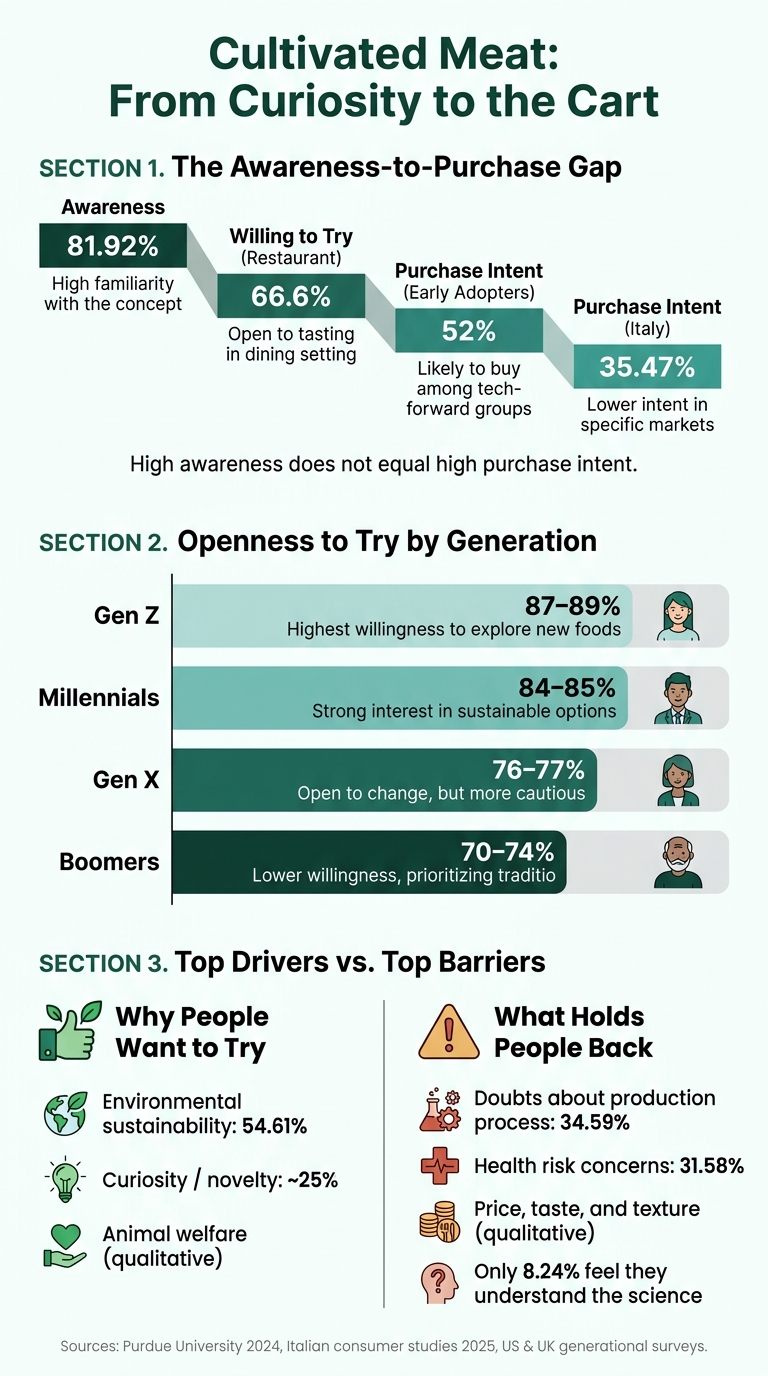
- In one 2024 Purdue study, 66.6% said they would order it in a restaurant.
- In Italy, awareness reached 81.92%, but purchase intent was only 35.47%.
- Younger adults are more open: 87–89% of Gen Z in the US and UK said they would try it, versus 70–74% of Boomers.
- The main reasons for interest are animal welfare, lower impact on the planet, and curiosity.
- The main barriers are price, taste, safety worries, and distrust of the production process.
- Repeat buying will depend less on novelty and more on cost, flavour, texture, labels, and trust.
In other words: high curiosity is not the same as adoption. If you want to know whether cultivated meat can move from headline numbers to normal food shopping, the key test is simple: can it feel safe, taste right, and fit a normal budget?
Purdue Expert: Lab-Grown Meat Consumer Trends
sbb-itb-c323ed3
What recent studies say about willingness to try, buy and eat Cultivated Meat
Cultivated Meat: Consumer Openness vs. Purchase Intent by Age Group
Trial, purchase and repeat-intent figures compared
Recent studies point to a pretty clear pattern: people are more open to trying Cultivated Meat than buying it, and buying interest is still higher than what we'd expect for regular use.
A 2024 Purdue University study found that 66.6% would order cultivated chicken or beef at a restaurant [5]. That sounds promising. But once the question shifts from trying it once to paying for it more often, interest drops.
You can see that sharply in Italy. Awareness reached 81.92%, yet purchase intent fell to 35.47%. The main reasons were health concerns and doubts about how the product is made [3]. Among early adopters aged 25–40 in developed markets, 52% reported purchase intent [6]. Put simply, a lot of people know about Cultivated Meat, but far fewer are ready to buy it. That gap between awareness and purchase intent is one of the clearest findings in the research [3][6].
The same pattern shows up across regions and age groups. Trial interest sits at the top. Purchase intent comes next. Then regular buying becomes the harder test. At the same time, there’s an important twist: among people who are already very or extremely likely to try it, repeat potential is strikingly high. 98–99% said they would consider buying it regularly [1][2].
Age and regional differences in consumer openness
The clearest divide isn't country by country. It's age.
Across the US and UK, 87–89% of Gen Z adults are at least somewhat open to trying Cultivated Meat, compared with 70–74% of Boomers [1][2]. Gen X lands in the middle at around 76–77% [1][2]. That pattern holds across the studies, which makes it look less like a regional blip and more like a steady age effect.
There are still regional differences, though. European countries with strong culinary traditions, such as Italy, tend to show more caution [3]. That makes sense. Food isn't just fuel; it's habit, memory and identity. So even when younger consumers show more openness, repeat purchase still hinges on trust, clear information and whether the product feels acceptable in day-to-day life.
Why consumers want to try Cultivated Meat
Those openness figures come from a few simple drivers.
Curiosity, animal welfare and lower environmental impact
The main reasons people want to try Cultivated Meat are sustainability, novelty and animal welfare.
Environmental sustainability leads the pack. In a study of Italian consumers, 54.61% of those interested in Cultivated Meat said it was their main motivation [3]. For most people, that points to one thing: a lower environmental impact.
Curiosity and the appeal of trying something new come next, influencing around 25% of interested consumers [3]. Some people want to see what all the fuss is about. Others are drawn to the idea of a new way to produce meat.
Animal welfare also plays a big part. Because Cultivated Meat does not require slaughter, it has clear appeal for people who care about how food is made and what sits behind it.
Curiosity helps open the door. But on its own, it rarely does the whole job.
Health, safety and the role of clear information
Health tends to be a concern rather than a selling point. But when people get clear information, confidence goes up.
Additional information increases support, which shows why plain, science-led communication matters [2].
This is especially important for older generations. They often want more reassurance that a product is safe, functional and worth buying before they move from interest to purchase [7]. Clear explanations of how Cultivated Meat is produced, how it is regulated and how safety is checked can help close that gap. Cultivated Meat Shop provides clear, science-led consumer guidance.
Even so, being willing to try something once does not mean someone will buy it again.
What turns a first try into a repeat purchase
A first try and a repeat purchase are not the same thing. Trial is often driven by curiosity and personal values. Repeat buying depends on taste, texture, price and whether the product fits into daily life.
Put simply, novelty gets people to the first bite; practicality brings them back.
What still holds some consumers back
High openness is a good sign, but people don’t buy food on interest alone. Trust, price and familiarity still shape the decision. Right now, three things keep coming up: trust, taste and price.
Concerns about naturalness, safety and unfamiliar foods
For many consumers, the issue isn’t curiosity. It’s whether Cultivated Meat feels safe and natural. A lot of people still picture a laboratory, and that image brings doubt with it. Even when people know what the term means, the production process can still feel unfamiliar [3][5].
That discomfort gets stronger when the food itself feels new or unusual. Research shows that higher scepticism sharply lowers purchase intent [3].
One 2025 study of Italian consumers puts numbers on that hesitation. 31.58% said health risks were a main reason for not purchasing, and 34.59% had doubts about how it is made [3]. At the same time, only 8.24% said they had a strong grasp of the science, which means most people are judging the category with limited understanding [3].
Taste, price and everyday practicality
Taste, texture, and safety have to match conventional meat. If the eating experience falls short, people may try it once and move on. That helps explain why early interest doesn’t always turn into regular buying [3][5].
Price is another sticking point. Cultivated Meat still costs more to produce than conventional meat, and reaching price parity remains a central challenge [3][1]. If shoppers are asked to pay more, they need a clear reason to do it again the next week, and the week after that.
Conditions that make adoption more likely
The same barriers start to look smaller when the product feels familiar, is clearly labelled and has official approval.
- Regulation: Clear, trusted regulation can help turn curiosity into a safer first purchase [3][1].
- Labelling: The word "cultivated" tests better than "artificial" or "synthetic", which can trigger negative associations and reduce appetite [4].
- Familiar formats: Presenting Cultivated Meat in familiar formats such as burgers, sausages and meatballs can lower perceived risk [5].
That’s why clear, practical information matters so much for first-time buyers.
What this means for UK consumers and the case for clear information
For UK consumers, the issue isn’t awareness. It’s turning interest into a purchase. That’s where the gap sits, and that’s why consumer education matters so much for UK adoption.
Why straightforward consumer information matters
This gap isn’t only about awareness; it comes down to trust. Studies show that while awareness can reach 81.92%, only 8.24% of consumers feel they have a strong grasp of the science [3].
That matters in the shop aisle. Clear labelling helps people understand what Cultivated Meat is, how it differs from plant-based products, and whether it suits what they want to buy. Most shoppers aren’t asking for a science lecture. They want plain answers on what cultivated meat tastes like, safety, price and sustainability.
How Cultivated Meat Shop helps consumers prepare
Until Cultivated Meat reaches UK shelves, consumers can still get ready with guidance they can follow. Cultivated Meat Shop gives UK consumers product previews, waitlist sign-ups and plain-English guides, so they can keep up with the category before it appears in shops.
Conclusion: High curiosity, but practical questions still matter
The next step after interest is reassurance. Across generations, openness is strong - 87–89% of Gen Z and 84–85% of Millennials say they would be willing to try Cultivated Meat [1] - but openness isn’t the same as adoption.
Interest is high. Repeat buying will depend on taste, price, trust and clear labelling.
FAQs
Why are so many people willing to try Cultivated Meat but not buy it regularly?
Lots of people are open to trying Cultivated Meat at least once. Buying it on a regular basis is a different story. That’s where doubt and old habits tend to kick in.
Many consumers can see the appeal. They may like the animal welfare angle and the lower impact on the planet. But they can still have questions about food safety, nutrition, and whether the process feels natural enough to trust.
There’s also the simple fact that unfamiliar food can make people wary. If something feels new or hard to place, scepticism is pretty normal. On top of that, conventional meat is still baked into many British eating habits, from weeknight dinners to Sunday roasts.
Cultivated Meat Shop helps close that gap by giving people clear, educational information in plain English.
Will Cultivated Meat ever cost the same as ordinary meat?
Yes. As production scales, Cultivated Meat is expected to reach price parity with conventional meat.
Right now, it still costs more to make. But costs have already started to fall as companies improve bioreactors, growth media, and manufacturing automation.
Current projections point to parity with premium conventional beef by 2028–2029, with broader mass-market competitiveness expected by 2032–2033.
How will shoppers know whether Cultivated Meat is safe?
Shoppers can feel confident because cultivated meat has to pass strict regulatory checks before it can appear on supermarket shelves. In the UK, regulators are putting rules in place to make sure these products meet high safety standards.
It’s also grown in controlled, sterile conditions, which can reduce the risk of contamination from pathogens such as E. coli and Salmonella. And with clear labelling, shoppers can spot these products easily and make informed choices.