If growth factors do not last, producers pay twice: once for the ingredient, and again for the extra top-ups. That is the core issue.
If I strip this down, the answer is simple: Cultivated Meat gets cheaper only when producers improve both growth factor stability and unit cost. A short-lived factor like standard FGF-2 can lose activity in under 10 hours, while a thermostable version such as FGF2-G3 can stay active for more than 7 days at 37°C. That gap can mean fewer media changes, lower protein use, and steadier cell growth. But if the ingredient price stays high - with research-grade bFGF2 at about £163.00 per unit - shelf prices still stay high.
Here’s the short version:
- Growth factors tell animal cells when to grow and develop
- Stability means how long those signals keep working
- Low stability leads to more waste and more frequent top-ups
- Lower unit cost helps, but not if batch use stays high
- The main target is cost per batch, not just cost per mg
- UK shoppers are likely to see first products at premium prices compared to conventional meat
Quick comparison
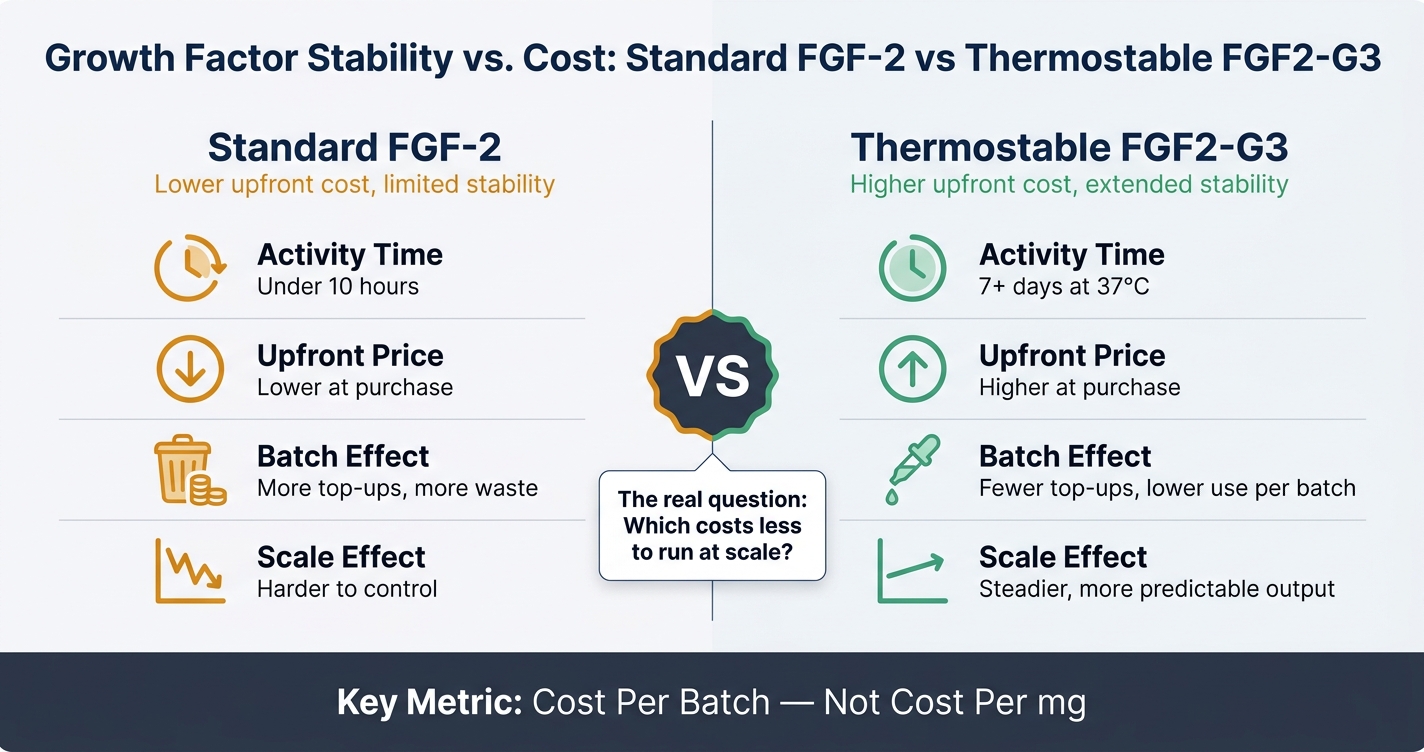
Growth Factor Stability vs. Cost: FGF-2 vs FGF2-G3 Compared
| Option | Activity time | Upfront price | Batch effect | Scale effect |
|---|---|---|---|---|
| Standard FGF-2 | Under 10 hours | Lower at purchase | More top-ups, more waste | Harder to control |
| Thermostable FGF2-G3 | 7+ days | Higher at purchase | Fewer top-ups, lower use per batch | Steadier output |
So when I look at the trade-off, I would not ask, “Which is cheaper to buy?” I would ask, “Which costs less to run at scale?”
sbb-itb-c323ed3
Why stability can lower costs over time
A higher upfront price can still cut total batch cost. So the main question isn’t the ingredient price on its own. It’s what the whole batch ends up costing.
Less waste and fewer top-ups
Standard FGF-2 breaks down fast, which means producers have to change media often. Thermostable variants like FGF2-G3 can stay active for more than 7 days [1][2], so teams can cut back on daily media changes.
That longer activity window means fewer top-ups and less protein used in each batch. In practice, the metric that matters is cost per batch, not cost per milligram [1][2].
More consistent production
Stability doesn’t just reduce waste and costs. It also makes production easier to predict.
When growth factor concentrations swing because the protein degrades fast, cells get mixed signals. The result can be uneven cell growth [1][3]. Stable growth factors keep those signals steadier, which leads to more uniform cell growth and more predictable output [1][3]. That becomes even more important at larger scale, where control gets harder [3].
But stability still needs to be weighed against ingredient cost.
Why cost reduction still drives affordability
Cost still sets the floor for affordability. Even if producers need fewer top-ups, the price of growth factors still shows up in the final shelf price. If those ingredients stay expensive, mass-market pricing stays out of reach. So cost reduction is still the other half of the affordability puzzle.
Why growth factors are such a large cost driver
Growth factors are among the most expensive media inputs, and in early-stage manufacturing they can make up a large share of total production costs [3][5]. Recombinant Bovine Fibroblast Growth Factor 2 (bFGF2) is priced at around £163.00 in research-grade quantities [6]. That figure reflects research-grade production, not food-scale manufacturing [4][6].
The industry is moving towards food-grade growth factors. These are ingredients that meet food-safety standards and are made with scalable, lower-cost processes [4]. Producers are also moving to simpler, lower-cost production methods [1][6]. But there’s a catch: a lower unit price only matters if it feeds through to the finished product.
How lower ingredient costs could affect shelf prices
When media costs drop, producers get more room to price products against conventional meat. That is what brings retail prices down [3].
UK and EU regulation is also pushing species-matched growth factors, such as bovine proteins for beef products [3][4]. Using species-matched ingredients can improve biological efficacy and may cut media use per batch [3]. But those more specialised ingredients still have to be made cheaply enough to affect shelf prices. The main price drop comes from cutting both waste and unit cost. That leaves producers trying to balance stability gains with the push for cheaper inputs.
Stability-first vs cost-first: the key trade-offs
Neither approach is simply "right" or "wrong". The real decision comes down to where you want to spend: on longer activity or on a lower per-unit price. You see that trade-off most clearly when you compare a thermostable factor with a cheaper, shorter-lived one. Each option fits different production goals, and each shapes process control and final cost in its own way.
When a stability-first approach makes sense
Thermostable factors stay active for longer, which means producers can use less media and step in less often. FGF2-G3, for example, maintains bioactivity for more than 7 days at 37°C [1][2], while standard FGF-2 has a half-life of less than 10 hours [3]. That gap can lower total batch cost, even when the ingredient itself comes with a higher price tag.
There is, however, a trade-off. Engineered proteins cost more upfront and may need extra regulatory review [1]. So the higher purchase price is only part of the picture; the process and compliance side matter too.
When a cost-first approach makes sense
The cheaper route cuts spending at the start, but some of those costs tend to show up later in operations. Using lower-cost, wild-type growth factors reduces immediate raw material spend and usually avoids the added complexity linked to engineered variants. On paper, that can look like the easy win.
The trouble often appears at scale. Short half-lives can mean daily media changes, higher total ingredient use, and more labour-heavy monitoring [2]. So a lower ingredient bill helps only if that saving still holds once production scales up.
Why the best answer is usually a balance
That is why most manufacturers do not treat this as a strict either-or decision. In practice, they tend to optimise between the two: enough stability to cut waste, and enough price discipline to keep media affordable.
The aim is fairly simple. Reduce total batch cost by cutting interventions, while keeping ingredient spend low enough to help bring shelf prices down [3][4].
What this means for UK shoppers
For UK shoppers, two things will shape when Cultivated Meat shows up on shelves and how much it costs: growth factor stability and cost. Those two are tightly linked. If growth factors last longer, there’s less waste. If they cost less per unit, shelf prices have more room to come down. That’s why the first products are very likely to sit at the premium end of the market.
In practice, the first hurdle isn’t only the science. It’s the cost per batch. Early products will probably come with premium price tags because Cultivated Meat is classed as a novel food in the UK, which adds time and cost before products reach shoppers [1]. On top of that, species-specific, food-grade growth factors are still hard to source, which keeps prices high [3][4]. Until production reaches a larger scale, ingredient costs will stay one of the main drivers of what people pay at the till.
Conclusion: lower prices depend on both sides of the trade-off
The answer comes down to balance. Better stability cuts waste, while lower unit costs help bring down shelf prices. For prices to fall, Cultivated Meat needs both longer-lasting growth factors and cheaper production [2][3][4]. Those two sides need to move together. The most likely route to more affordable Cultivated Meat in the UK is smarter ingredient engineering paired with lower ingredient prices, not one without the other.
FAQs
Why does growth factor stability matter so much?
Growth factor stability matters because it shapes cost, day-to-day operations, and batch consistency in Cultivated Meat production.
Growth factors can account for up to 99% of culture media costs. So their functional half-life has a direct effect on how much you need to use. If a growth factor stays active for longer, you can often use less of it over time. That can make a big difference to spend.
There’s also the practical side. Some proteins, such as FGF-2, break down fast. When that happens, teams need to change the media more often to keep cells growing as expected. That adds work, uses more inputs, and can make the process harder to run smoothly.
More stable growth factors also help with cell behaviour. They support more uniform cell growth and help maintain consistent product phenotypes. In a production setting, that kind of consistency isn’t just nice to have. It helps keep outcomes steadier from one batch to the next.
Is a higher-priced growth factor always cheaper overall?
Not always. A higher-priced growth factor can end up costing less overall if it performs better or holds up for longer.
For example, more thermostable engineered proteins can cut how often media needs changing and reduce the amount of growth factor required. That can lower total production costs. On the flip side, cheap, low-quality inputs can hurt cell health and make results less consistent.
What needs to improve before Cultivated Meat becomes more affordable?
To hit £8 per kilogram, growth media costs need to drop - a lot. Right now, they can account for up to 99% of production costs, which makes them one of the biggest hurdles in getting Cultivated Meat to a workable price point.
A few changes matter most here. Producers need to cut the cost of growth factors, move production from small-scale lab settings to food-grade industrial manufacturing, and use media more efficiently so fewer litres are needed for each kilogram of Cultivated Meat.